September 3, 2026 • Callum Dray • 9 min reading time • Prices verified June 6, 2026
Hat Stretchers for Felt, Leather, and Wool: A Practical Buyer's Guide
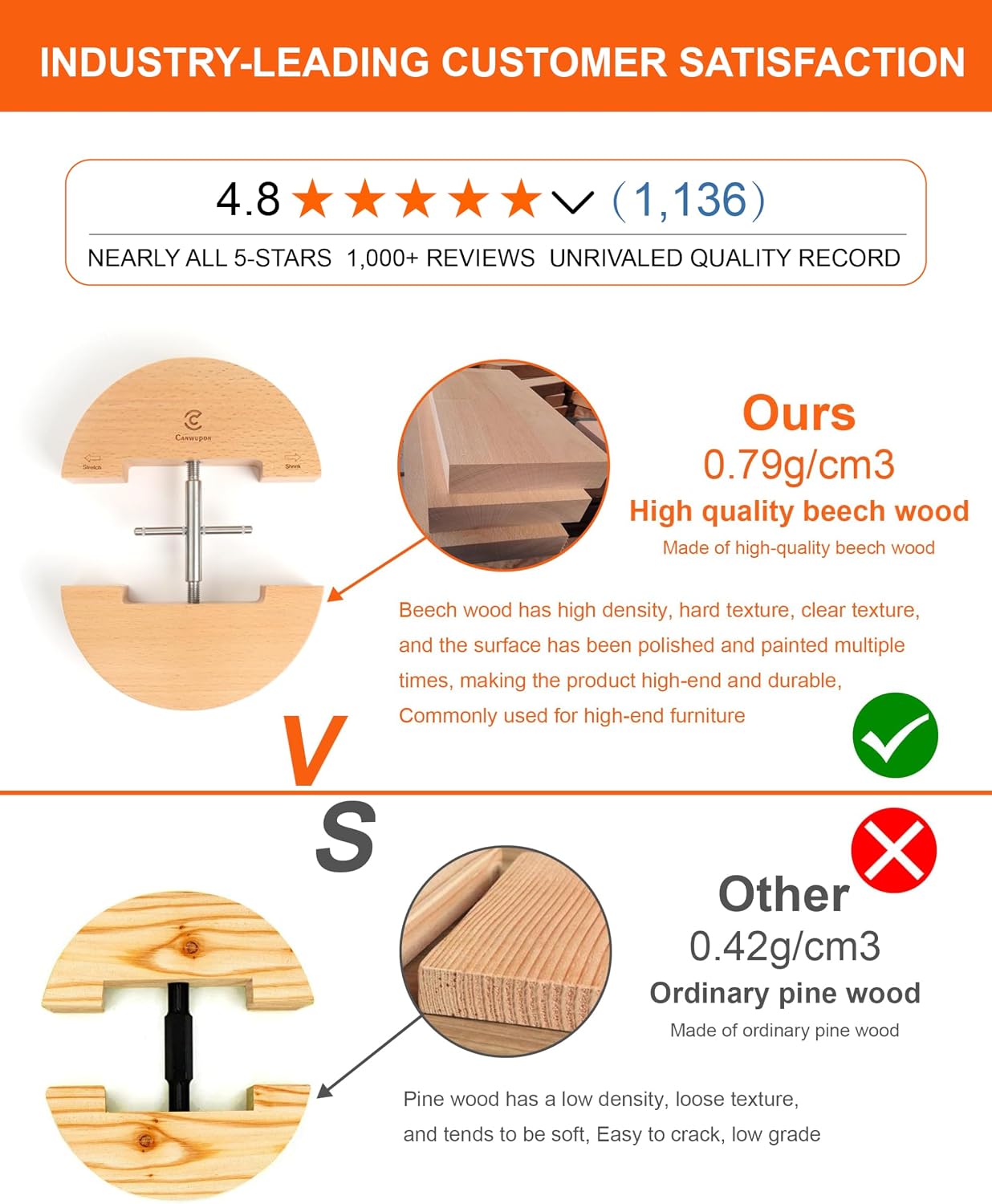
A hat stretcher is exactly what the name says: a wooden or plastic device you insert into the crown of a hat (the rounded dome that sits on your head) and expand outward until the headband and felt or fabric ease into a larger size. That’s the whole mechanism. Where it gets interesting — and where this guide earns its keep — is in understanding which stretcher design works for which hat shape, how much stretch is actually safe before you risk warping a $300 Akubra, and why inherited or washed hats that “almost fit” are genuinely good candidates for this fix rather than an expensive re-block. Whether you’ve just acquired a hat from a family member, bought one online that arrived a half-size too small, or own a fine wool felt that shrank after an unexpected downpour, this guide will walk you through the decision clearly.
| EDITOR'S PICKHat Stretcher 4 Way | Mid-tierHat Stretcher 4 Way | Budget pickHat Stretcher for Fitted Hats a… | |
|---|---|---|---|
| Sizes | 6 7/8 to 8 1/2 | 6 7/8 to 8 1/2 | — |
| Wood | Walnut | — | Solid wood |
| Hardware | — | — | Stainless steel |
| Handle | — | — | ✓ |
| Color | Brown | Silver | — |
| Model | 4 Way | 4 Way | — |
| Price | $23.99 | $21.83 | $14.99 |
| See on Amazon → | See on Amazon → | See on Amazon → |
Two-Way vs Four-Way: Why Crown Shape Is the Real Decision Driver
This is the fork in the road, and getting it wrong costs you either a piece of kit that doesn’t work or a hat that stretches unevenly.
A two-way stretcher expands along a single axis — side to side, typically. Turn the central screw and the two wooden halves press outward. It does exactly one thing well: adding circumference to a round crown. Baseball caps, round-crown woollen beanies, and some bucket-style hats sit comfortably in this category.
A four-way stretcher has an additional set of expansion plates that push forward and backward simultaneously while the side plates expand left and right. The result is a controlled oval expansion. This matters enormously for Australian outback hat buyers, because the dominant crown shape in the Akubra catalogue — and in nearly every Barmah and RM Williams-adjacent style — is oval, not round. The human head is oval in plan, and Australian fur-felt hats are blocked to match that. Stretching an oval-crowned hat with a two-way device pushes it round; your hat will sit high and unstable rather than dropping cleanly onto your head.
Reviewers of four-way stretchers consistently make this point in practical terms: owners who have used them to salvage inherited hats — including several accounts of resizing expensive fitted hats from a deceased relative’s collection — specifically note that the four-way design is what allowed a hat with an existing oval set to be widened without distorting the crown geometry. That’s not a small thing. A fur-felt Akubra Snowy River or a hand-blocked Cattleman costs between $200 and $400; keeping its shape integrity while resizing is the whole point.
By the numbers:
| Stretcher type | Expansion direction | Best crown shape | Typical safe stretch range |
|---|---|---|---|
| Two-way screw | Side to side only | Round | ½ to 1 cm per axis |
| Four-way expanding | Side + front/back | Oval | ½ to 1 cm per axis, proportionally |
Multiple owners in long-run reviews report using the two-way screw model specifically for incremental adjustments of around one centimetre — enough to fix a hat that shrank slightly from a wash or to move from a snug fit to a comfortable all-day wear. At least one reviewer documented using it to eliminate chronic headaches from hat-compression after their hat had shrunk from a washing incident. One centimetre of additional circumference sounds trivial; in practice it represents the difference between a hat you wear daily and one that stays on the shelf.
Fur Felt, Wool Felt, and Leather: How Material Changes the Approach
Not all hat materials respond to stretching the same way, and understanding the difference will stop you from ruining something expensive.
Fur felt — the material in a genuine Akubra, graded by the density and fineness of the rabbit or hare fur — is a compressed, matted fabric rather than a woven one. The fibres are interlocked under heat and pressure during manufacture. The good news: fur felt has a meaningful degree of elasticity and responds well to gradual, damp-assisted stretching. The Akubra official care documentation notes that the felt will relax when warmed and dampened, which is precisely the principle a stretcher exploits. The risk is over-torquing: felt fibres that are forced beyond their elastic range will thin, show stress marks, or lose the surface finish that distinguishes a quality hat from a cheap one.
Wool felt — used in mid-range crushable styles and some Barmah offerings — is generally more forgiving than fur felt because the fibres are slightly coarser and the weave less tight. Country Life’s felt hat care feature notes that wool felt tolerates humidity and reshaping better than pure fur felt, though it also has a lower ceiling for premium finish. Practically: you can be marginally more aggressive with a wool felt crushable than with a heritage Akubra, but the same one-centimetre rule applies.
Leather sweatbands — found in most quality Akubras and in the better Jacaru and RM Williams styles — are actually the component most likely to limit your stretch range. Leather has directional grain and a finite stretch tolerance before it either creases permanently or pulls away from its stitched attachment to the crown. Heddels’ hat stretching explainer flags this as the practical ceiling for any stretching operation: the sweatband, not the felt, is usually what gives out first if you push too hard. This means your safe range on a leather-banded hat is governed by the sweatband’s condition as much as the felt’s.
The damp-cloth technique deserves specific mention here. Multiple owners describe pressing a slightly damp cloth against the interior of the hat — particularly around the sweatband — before inserting and expanding the stretcher. The moisture relaxes both the felt fibres and the leather sweatband slightly, reducing resistance and lowering the risk of stress marks. Apartment Therapy’s guide on unshrinking fabric materials confirms the underlying principle: heat and moisture temporarily reduce fibre tension, allowing controlled reshaping before the material sets again in its new position. For a fur-felt Akubra, use cool or barely-warm water on the cloth — not hot. Hot moisture can mat the surface nap and is responsible for more damaged hats than over-stretching.
The Inherited Hat Scenario: A Decision Framework
This is the highest-value use case for hat stretchers, and it comes up more often than you’d expect among serious collectors. The scenario: a quality hat — often an Akubra Cattleman, a Snowy River, or a custom-blocked piece — has been sitting in a wardrobe for years and fits the new owner almost perfectly but not quite. A full re-block by a milliner is the gold standard but costs between $60 and $120 in most Australian capital cities (as of mid-2026), takes several weeks, and often requires the hat to be shipped interstate.
A four-way stretcher costs a fraction of that and, used correctly, achieves a comparable result for the most common scenario: a hat that is one size too small. The framework is simple:
- Gap of less than 1 cm (hat sits on the head but feels tight after an hour): stretcher is the right first move. Start with the damp-cloth technique, expand gradually, leave overnight, check fit.
- Gap of 1–2 cm (hat won’t drop to the correct position on the head): stretcher can work but needs multiple sessions over several days with rest intervals between. Do not try to close the gap in one session.
- Gap of more than 2 cm (hat sits noticeably high, won’t fit at all): a milliner re-block is the honest recommendation. Stretching tools have limits, and forcing a hat two or more sizes is a reliable way to distort the crown permanently.
The Australian Geographic feature on Akubra’s manufacturing heritage notes that Akubra hats are blocked in standardised sizes (53 cm to 63 cm, in 1 cm increments) and that the crown geometry is set under significant heat and pressure during production. That set is durable but not immovable — a professional block can reset it; a careful home stretching operation can ease it by a size without undoing it.
Using a Stretcher for Storage, Not Just Resizing
This application gets underused. A hat stretcher inserted at the correct fit size — not expanded beyond it — acts as a crown form during storage, maintaining the internal geometry of the hat between wears. This matters for fur-felt hats in particular, which can develop internal flat spots or slight oval distortion when stored crown-down or in a bag.
Owners in long-run reviews note that the four-way model, left expanded to the wearer’s head size inside the stored hat, effectively functions as a custom hat block for home use. It won’t replace the shape-setting function of a professional block, but it reliably prevents the slow deformation that accumulates when a fine hat is stored carelessly over months or years. For a $300–$400 Akubra, the cost of a four-way stretcher as storage insurance alone is easy to justify.
Frequently Asked Questions
Can you use a hat stretcher on a fur-felt Akubra without damaging the felt? Yes, with caveats. The damp-cloth preparation step is not optional for a fur-felt hat — dry-stretching fur felt risks stress marks on the surface nap. Expand gradually (a quarter-turn on a screw stretcher at a time), leave for several hours between adjustments, and stay within the one-centimetre-per-session limit. The Akubra care guide’s general principle of avoiding excessive moisture applies equally here: damp, not wet.
How much can you safely stretch a hat before the sweatband or crown distorts? The practical ceiling reported by owners across multiple hat types is approximately one full hat size, which equates to roughly 1 cm of additional circumference. The leather sweatband is typically the limiting component, not the felt. If the sweatband shows visible puckering or the stitching begins to pull, stop.
Will stretching fix a hat that shrank after getting wet? Usually yes, for moderate shrinkage. A hat that got caught in rain and dried tight is an ideal candidate — the felt has been through one damp-and-dry cycle already and will respond predictably to another controlled one. Heddels’ stretching guide specifically addresses this as one of the most common and fixable scenarios.
Is a four-way stretcher worth the extra cost over a two-way for an oval-headed buyer? If you own or plan to own any Australian outback-style hat — Akubra, Barmah fur felt, Cattleman, Snowy River — the four-way is the correct tool. The two-way stretcher will widen the hat but it will pull the crown toward round. For an oval-crowned hat that needs to fit an oval head, that’s a net loss. The cost difference between the two types is small relative to the value of the hat you’re working on.
Can a stretcher be used to maintain crown shape in storage, not just to resize? Yes, and this is arguably the most overlooked application. A four-way stretcher expanded to your exact fit size and left inside the hat during storage acts as a home hat block, preventing the slow internal deformation that accumulates over months of improper storage. For any hat at the $150-and-up tier, the storage-maintenance use case alone justifies the purchase.