August 19, 2026 • Callum Dray • 10 min reading time • Prices verified June 6, 2026
The Kangaroo and Cattle Leather Hat From Australia: What Owners Discover After Six Months
If you’ve landed here wondering whether an Australian leather hat is worth the investment over a wool-felt or oilskin option, you’re in the right place. Leather hats — made from either cattle hide (the same material as a classic leather jacket) or kangaroo hide (lighter, finer-grained, and genuinely unusual in global hat markets) — represent a distinct third category in Australian bush headwear. They’re not the shapeable, crushable fur-felt of an Akubra, and they’re not the waxed-cotton water-resistance of an oilskin drover. What they offer is their own set of tradeoffs: natural structure, distinctive texture, and a patina — the darkening, character-deepening surface change that develops over years of wear — that many owners describe as the whole point. This article works through what buyers of kangaroo and cattle leather hats actually encounter once the novelty wears off: the fit surprises, the weather performance, the care requirements, and the crucial question of whether “Australian-style” means the same thing as “Australian-made.”
| EDITOR'S PICK1078 Kangaroo Classic - Austral… | Mid-tier1076 Kangaroo Cooler - Australi… | Budget pickLeather Down Under HAT Aussie B… | |
|---|---|---|---|
| Leather | Kangaroo | Kangaroo | — |
| Aussie made | ✓ | ✓ | — |
| Foldable | ✓ | ✓ | — |
| Travel bag | ✓ | ✓ | — |
| Size | Large | Large | X-Large |
| Color | Hickory | Hickory | Brown/Black |
| Price | $125.00 | $115.00 | $47.99 |
| See on Amazon → | See on Amazon → | See on Amazon → |
The Kangaroo vs. Cattle Leather Question: Why It Actually Matters for Hat Buyers
This is the first decision point, and it’s worth slowing down on.
Australian Geographic, in their published reporting on kangaroo leather (“Kangaroo Leather: The Facts,” australiangeographic.com.au), notes that kangaroo hide has a unique fibre structure — the collagen fibres run parallel to the skin surface rather than at angles, which produces a material that is exceptionally strong relative to its weight. Cattle leather, by contrast, is thicker and heavier for equivalent durability. For hats, that difference is immediately tangible.
By the numbers:
- Kangaroo leather is commonly cited by tanners as delivering comparable tensile strength to cattle leather at roughly 50% of the weight
- A finished kangaroo leather hat typically lands in the 180–250g range; equivalent cattle leather constructions often run 280–380g
- Both outperform most synthetic brim materials for long-term UV resistance, a point consistent with Outside Online’s overview of leather gear durability (“How to Care for Leather Gear in Harsh Conditions,” outsideonline.com)
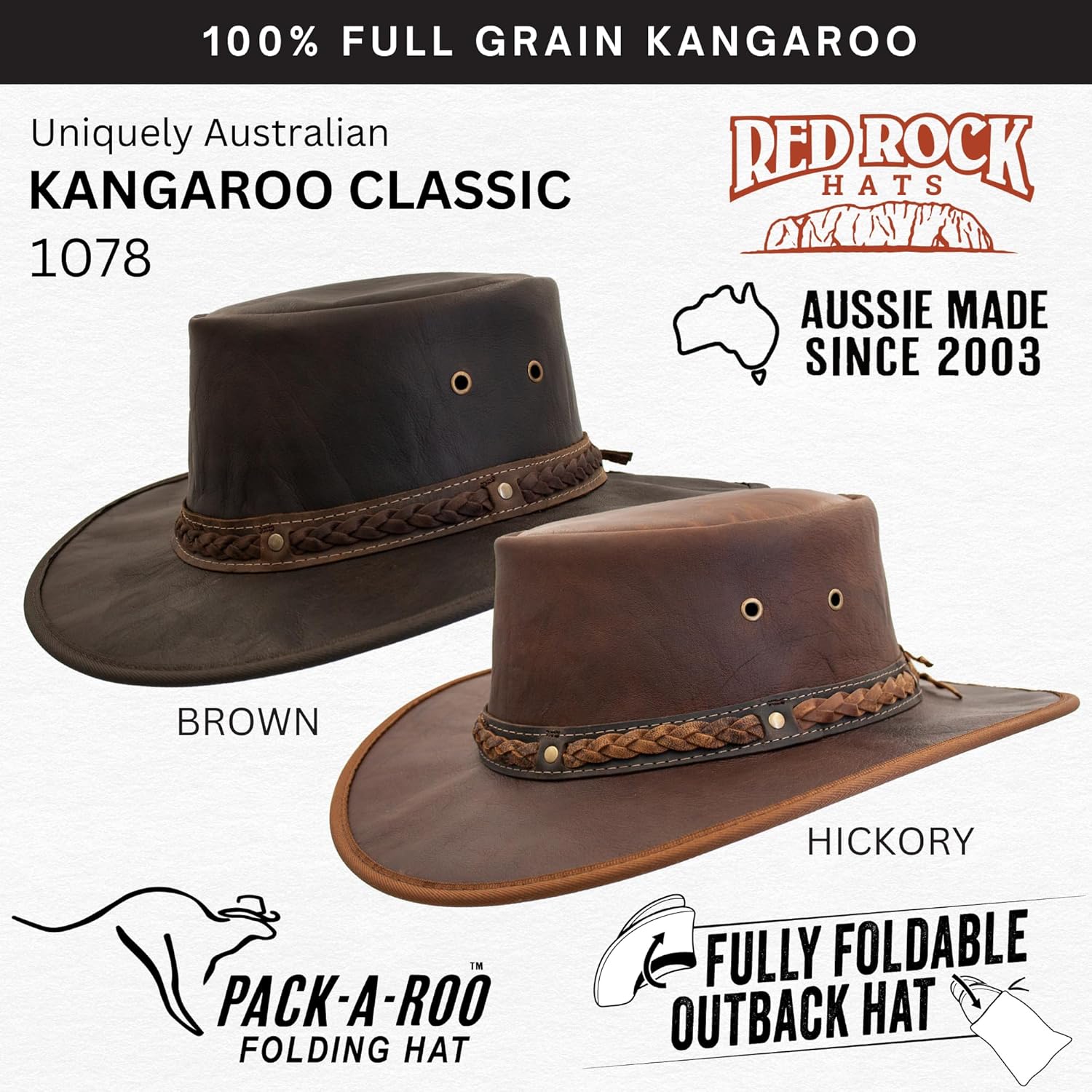
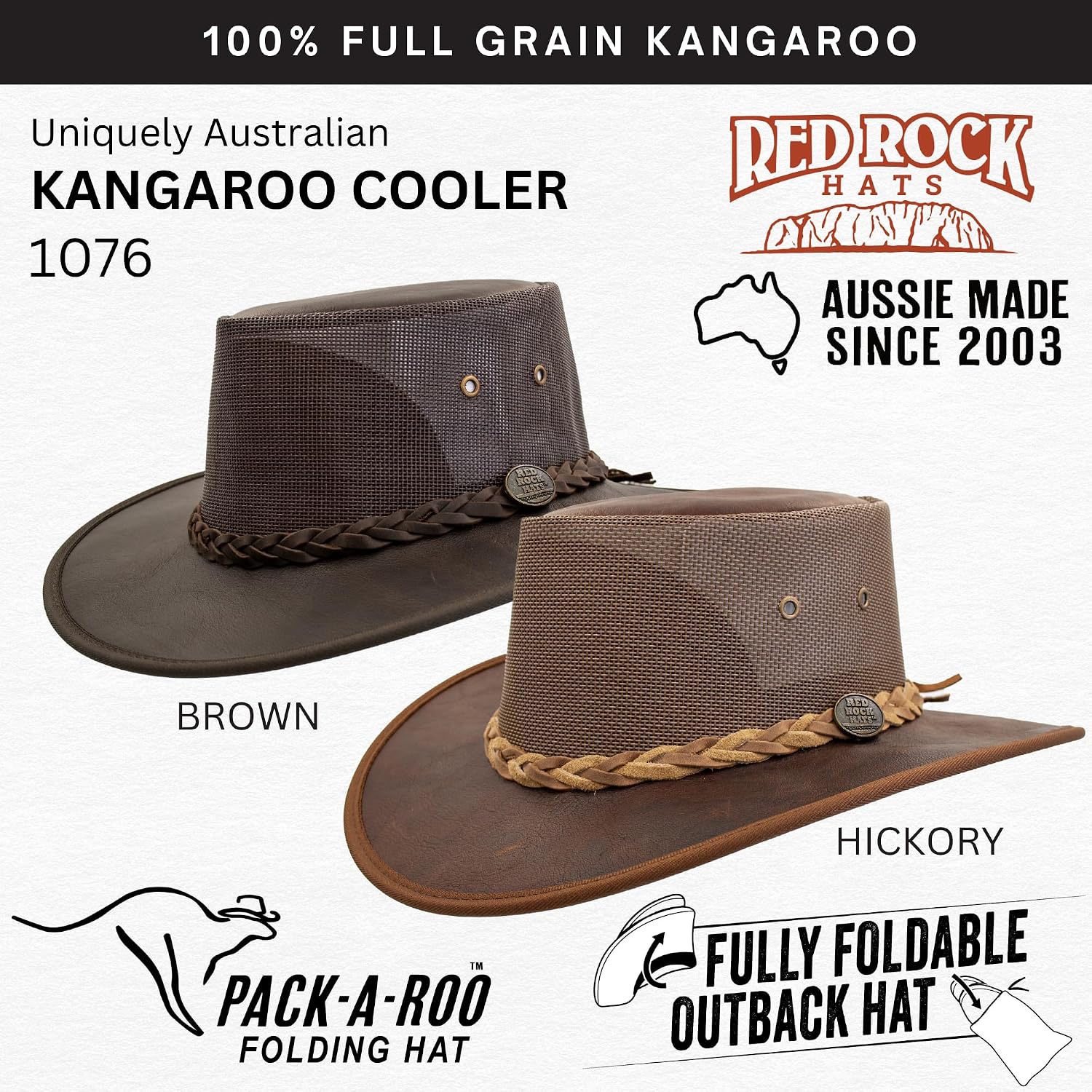
Owners of the 1078 Kangaroo Cooler and 1078 Kangaroo Two Tone hats consistently note one thing above all: the hat is lighter than they expected. For buyers who have handled oilskin hats or heavy wool-felt crushables, the first lift of a kangaroo leather hat often registers as a surprise. One reviewer — a melanoma survivor who describes trying “literally dozens” of hats in a focused search for maximum brim coverage without neck fatigue — calls the Kangaroo Cooler the winner across every category she evaluated, specifically crediting the weight-to-coverage ratio. Another describes it as a “forever hat” from the first wearing, which is a strong claim but one that aligns with what kangaroo leather’s material properties would predict: it softens and conforms without losing structural memory the way cheaper synthetic or pressed-fibre brims do.
Cattle leather hats occupy a different niche. They’re heavier, they take longer to break in, and their stiffness is often read as premium construction by first-time buyers — which it can be, but it can also just mean you’re carrying more material. The Australian Leather Cowboy Hat earns praise in owner reviews for brim curvature and leather quality, but reveals a recurring fit problem worth naming explicitly: reviewers report that the small size runs tight and the medium runs loose, with no half-size or adjustable-band option bridging the gap. For cattle leather specifically — which doesn’t stretch or conform as quickly as kangaroo — that fit gap is a real problem. A hat that’s marginally too tight in fur-felt might soften and ease over weeks; cattle leather is less forgiving on that timeline.
1076
$115.00
In stock on Amazon
Check price on AmazonThe “Australian-Style” vs. “Australian-Made” Distinction You Need to Make Before Buying
This is where considered buyers earn their due diligence.
The Australian outback hat aesthetic — wide brim, structured crown, earthy tones — is widely produced offshore and marketed with terms like “Australian-style,” “outback-inspired,” or “bush hat design.” None of those phrases guarantee Australian materials or Australian labour. Heddels, in their “A Complete Guide to Leather Grades and Tanning Methods” (heddels.com), distinguishes clearly between provenance claims attached to style versus those attached to supply chain, and the gap between the two is commercially significant.
The 1078 Kangaroo range draws buyers who have specifically researched this question. The kangaroo leather itself is sourced from Australia — kangaroo harvesting for commercial leather is a regulated industry under Australian state wildlife management programs, as documented by Australian Geographic (“Kangaroo Leather: The Facts,” australiangeographic.com.au) — though buyers asking whether the full hat is designed and assembled in Australia should read product listings carefully and contact the maker directly. This is candid advice rather than a criticism: even hats using genuine Australian kangaroo leather may be finished elsewhere, and for some buyers that distinction matters; for others, the material provenance is the primary concern.
1078
$125.00
In stock on Amazon
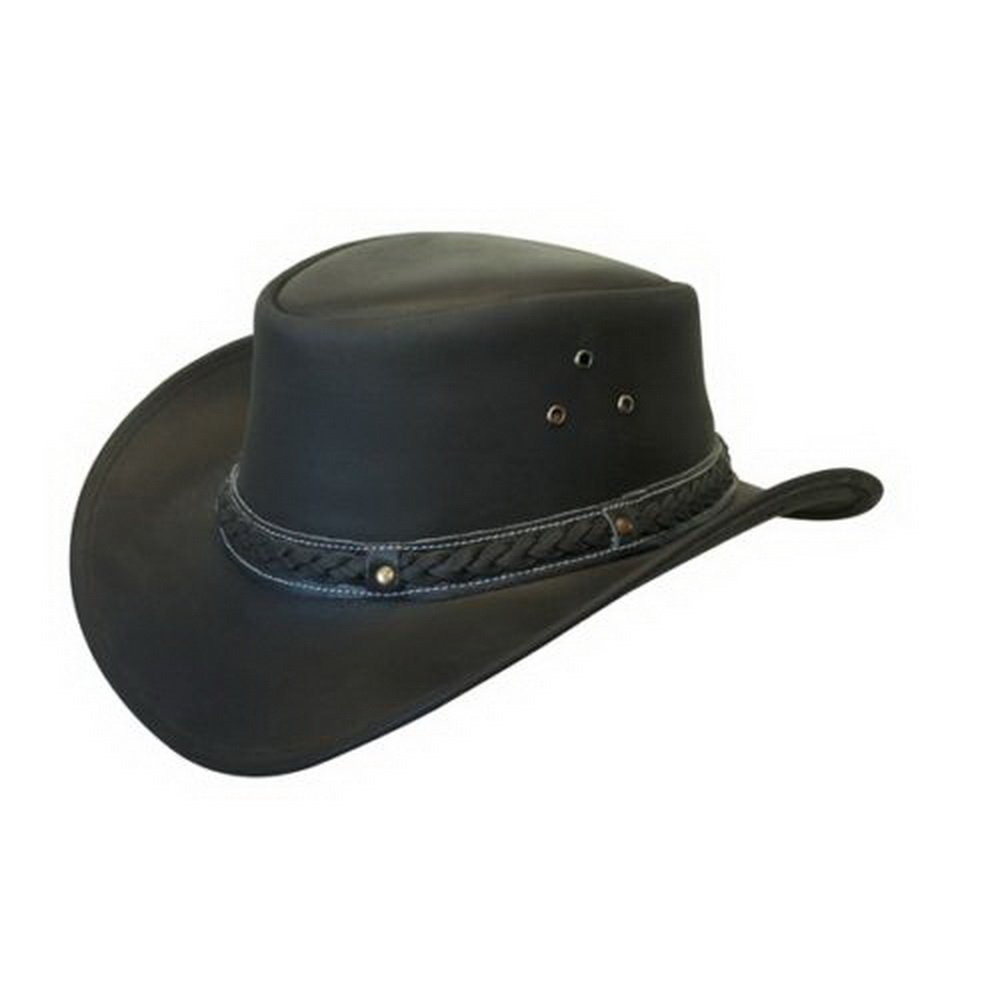
Check price on AmazonBy contrast, the Leather Down Under Aussie Bush Hat illustrates what happens when the aesthetic promise and the execution diverge. Owner reports describe the hat arriving in a plain plastic bag with the crown visibly smushed — a packaging approach that immediately signals a different tier of manufacturer care. First impressions from unboxing are not trivial: a hat that requires reshaping before it’s worn for the first time creates doubt about whether the leather’s structural memory is reliable over the longer term. This isn’t conclusive evidence of a quality problem, but it’s the kind of signal that experienced buyers read correctly.
Leather
$47.99
In stock on Amazon
Check price on AmazonThe Oztrala oilskin-leather hybrid (HL31) occupies an interesting middle position — combining oilskin’s water resistance with leather’s structure — but reproduces the same sizing complaints seen across the cattle leather category: half-sizes and head widths that fall between available options. For buyers with heads outside the standard sizing band, this is a recurring theme across leather hats and worth measuring carefully before committing.
1076
$115.00
In stock on Amazon
Check price on AmazonRain, Travel, and the Practicalities That Reviews Actually Surface
Rain performance is the question leather hat buyers ask most often, and the honest answer is nuanced. Country Life, in “The Working Hat: What to Look For in a Serious Field Hat” (countrylife.co.uk), notes that untreated or poorly maintained leather can absorb water, stiffen on drying, and lose shape — but well-conditioned leather with a surface treatment applied regularly performs respectably in moderate rain, shedding light showers and drying without deforming if the owner has maintained the leather’s oils. Kangaroo leather’s tighter fibre structure gives it a slight edge over cattle leather here: it absorbs less water before conditioning is needed, and it dries faster.
Compared directly to oilskin: oilskin wins in heavy sustained rain, full stop. The wax impregnation in a quality oilskin drover is designed specifically for that environment. Leather is not a substitute in a high-rainfall working environment. But for high-UV, dry-heat conditions where you also want occasional rain protection — the Australian interior, high-desert regions, long-haul travel in variable climates — leather makes a genuine case.
Travel foldability is the other practical test, and the 1078 Kangaroo Two Tone specifically earns points here. One owner documents using the hat across multiple US states — Washington, Florida, Michigan — specifically because the design tolerates being folded for packing without cracking or losing its shape. That’s a meaningful data point. Kangaroo leather’s pliability, when properly conditioned, allows a degree of flexibility that cattle leather — especially thicker cuts — cannot match without risk of crease lines forming. The rule of thumb from Outside Online’s leather care guidance (“How to Care for Leather Gear in Harsh Conditions,” outsideonline.com) applies here: a leather hat that is regularly conditioned with an appropriate product stays supple enough to flex; one that has dried out will crack at fold points.
Sizing deserves its own moment, because the pattern across multiple leather hat reviews is consistent enough to treat as a category-level finding rather than a product-specific complaint. Leather hats do not have the steamer-adjustable give of felt hats, and they break in more slowly than canvas. If you’re between sizes, the correct move is to contact the maker before ordering, measure your head circumference accurately at the widest point (above the ears, across the forehead), and if the brand offers no half-size, err toward the larger option and use a hat sizing liner — a thin foam or leather strip that adheres inside the sweatband — to close the gap.
How to Maintain a Kangaroo Leather Hat for Decade-Long Wearability
The owners who report the best long-term outcomes share a common practice: they treat the hat before problems appear, not after.
Outside Online’s leather gear care overview (“How to Care for Leather Gear in Harsh Conditions,” outsideonline.com) is consistent with what specialist hatters recommend. The maintenance sequence for a kangaroo or cattle leather hat breaks down as:
- Condition on a schedule, not on damage. Apply a lanolin-based or neatsfoot oil-based leather conditioner two to four times per year, more frequently in hot-dry or high-UV environments. The goal is maintaining the leather’s oil content before it drops low enough to cause brittleness.
- Dry away from direct heat. If the hat gets wet, reshape it by hand and allow it to dry at room temperature. Direct sun or a heater will pull moisture out unevenly, causing warping.
- Store on a hat block or crown-down. A kangaroo leather hat that spends months crushed in a cupboard will develop a set in the wrong shape. A simple wooden hat block — or even a rounded tin of the right circumference — preserves the crown geometry.
- Clean gently. A slightly damp cloth for surface dust; a dedicated leather cleaner for salt or sweat staining on the sweatband. Avoid soap, which strips oils.
- Re-treat after heavy rain. Water displaces conditioning oils. After any significant rain exposure, let the hat dry fully and then condition before the next wear.
Owners who follow this routine consistently describe kangaroo leather hats as improving with age — developing a deeper colour, a more personal fit, and a surface character that new hats don’t have. That earned patina is, for many buyers, the actual return on investment.
Frequently Asked Questions
What is the practical difference between kangaroo leather and cattle leather in a hat — which is lighter? Kangaroo leather is significantly lighter. Australian Geographic’s reporting on kangaroo hide (“Kangaroo Leather: The Facts,” australiangeographic.com.au) confirms its fibre structure produces strength comparable to cattle leather at roughly half the weight. In hat form, that translates to a noticeably lighter feel during extended wear — a real advantage for full-brim sun-coverage styles that would otherwise cause neck fatigue.
Are the 1078 Kangaroo hats genuinely made in Australia, and does that affect quality? The kangaroo leather is sourced from Australia, where commercial kangaroo harvesting is regulated under state wildlife management programs. Whether full assembly occurs in Australia varies by product; buyers who prioritise Australian manufacturing should confirm directly with the seller. Material provenance is verifiable; assembly location requires checking.
How does a kangaroo leather hat hold up in rain compared to oilskin or felt? Well-conditioned kangaroo leather handles light to moderate rain acceptably and dries without deforming. Oilskin is the stronger choice for heavy or sustained rain — its wax impregnation is purpose-built for that condition. Fur-felt holds its own in light rain but can be damaged by sustained soaking. Leather sits between the two for water performance, and condition maintenance is the determining variable.
Can a leather outback hat be folded or rolled for travel without cracking? Kangaroo leather, when properly conditioned, tolerates folding better than cattle leather. The 1078 Kangaroo Two Tone has owner-documented travel use across multiple climates with no reported cracking. Dried-out leather of either type will crack at fold points — conditioning before travel is non-negotiable.
How should I care for a kangaroo leather hat to maintain suppleness and shape over many years? Condition two to four times yearly with a lanolin or neatsfoot oil product, dry at room temperature after rain, store on a hat block, and re-treat after heavy wet exposure. Owners who follow this routine report hats that improve rather than degrade over five to ten years of regular wear.