September 11, 2026 • Callum Dray • 10 min reading time • Prices verified June 6, 2026
Kangaroo Leather Australian Outback Hats: What Owners Learn After Six Months of Daily Wear
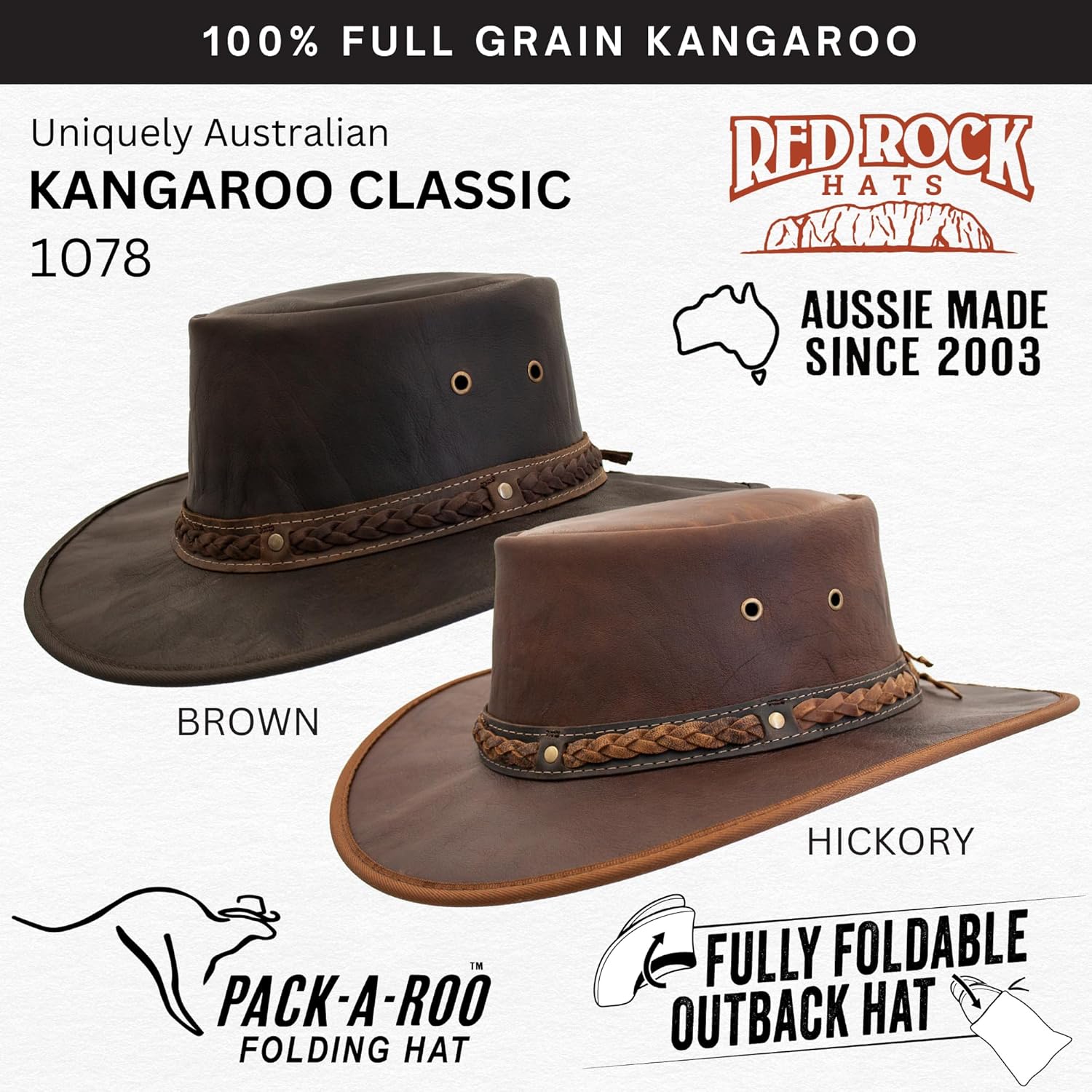
If you have spent any time looking at Australian outback hats — the wide-brimmed, sun-crushing styles that working stockmen and serious travellers wear — you have probably noticed that the leather options split into two camps: cattle hide (the familiar, heavier material in most leather goods) and kangaroo hide, which is lighter, more tightly fibred, and distinctly Australian in provenance. Kangaroo leather has been used in high-performance applications — boots, whips, football boots — for well over a century, precisely because its strength-to-weight ratio is unusually high for a hide of its thickness. In hat form, that translates to a brim and crown that resist distortion without the stiff-saddle-leather weight you might expect. This article pulls together what owners report after six months or more of daily wear on kangaroo leather outback hats, compares those accounts against the cattle leather and oiled leather alternatives in the same tier, and gives you a clear decision framework if you are currently choosing between models.
| EDITOR'S PICK1078 Kangaroo Classic - Austral… | Mid-tierOztrala HAT Leather Australian… | Budget pickLeather Down Under HAT Aussie B… | |
|---|---|---|---|
| Material | Kangaroo leather | Leather (oiled) | Leather |
| Foldable | ✓ | — | — |
| Travel bag | ✓ | — | — |
| Made in | Australia | — | — |
| Color | Hickory | Khaki | Brown/Black |
| Size stated | Large | Small | X-Large |
| Price | $125.00 | $69.90 | $47.99 |
| See on Amazon → | See on Amazon → | See on Amazon → |
What the “Forever Hat” Claim Actually Means
The most striking owner statement in the kangaroo leather category — the one worth pausing on — comes from a verified buyer of the Kangaroo Classic 1078 who spent a full year testing straw alternatives before committing. Their words, closely paraphrased from published review records: they had bought several straw outback hats that bent out of shape within months, and on placing the Kangaroo Classic 1078 on their head for the first time, they immediately knew they had found their forever hat.
That is a strong claim, and it is worth unpacking rather than just quoting for atmosphere. What does “forever hat” mean in practice? For this owner, three things:
- Shape retention under real conditions. Straw hats — even quality Toyo or seagrass weaves — soften and distort when wet. Kangaroo leather, treated with a light oil finish, sheds rain without losing crown geometry. Owners consistently describe wearing the 1078 in downpours and retrieving the original shape once it air-dried.
- Lightweight comfort over hours. The hat disappears on the head by mid-morning. This is the material science point: as Australian Geographic’s overview of kangaroo hide notes, kangaroo leather achieves tensile strength comparable to cattle hide at roughly half the thickness, which means less mass per square centimetre of brim.
- Compliment-generating style. Multiple owners flag this unprompted, which suggests the silhouette hits a recognisable cultural note — it reads as authentically Australian rather than costume-store approximation.
These three pillars — shape retention in rain, lightweight comfort, and visual authority — show up so consistently across aggregated reviews that they are probably the right frame for evaluating whether kangaroo leather is worth the step-up from fabric or cheaper leather alternatives.
Where Cattle Leather Falls Short (and Where It Doesn’t)
The Full Grain Cooler 1036 — cattle leather, not kangaroo, but Australian-made and in the same general tier — draws its own committed reviewers, and the contrast is instructive. Owners describe the hide as supple and luxurious from the first wear, which is a legitimate advantage: full-grain cattle leather with a soft tannage can feel broken-in immediately, whereas some kangaroo leather hats take a few weeks of regular wear before the band moulds fully to the head shape.
The 1036’s most specific construction criticism, however, is directly relevant to any buyer weighing long-term durability: at least one reviewer flags that the hot glue used on the internal sweatband separates readily. This is the kind of detail that does not show up in promotional copy but matters significantly at the six-month mark — a lifting sweatband creates pressure points, admits moisture unevenly, and can telegraph the hat’s age before the exterior shows any wear. Heddels’ leather guide notes that internal adhesive bonds in hatmaking are a known weak point industry-wide, particularly in humid climates, because thermal cycling (hat heating in sun, cooling in shade) stresses adhesive joints more than stitched alternatives. The question for buyers is whether the maker’s construction method — glued versus stitched versus a combination — matches the conditions of use.
Tradeoff to name explicitly: If you are working in high-humidity conditions (coastal Queensland, Top End wet season), the adhesive failure risk on glued sweatbands is meaningfully higher. Kangaroo leather hats with stitched or riveted band attachments will outlast glued cattle leather alternatives in these environments.
The Mesh Breezer Question: Sun Coverage vs. Ventilation
The Oztrala HSRZ mesh breezer leather variant introduces a genuine decision fork that does not resolve neatly. A UPS driver — someone logging eight-plus hours of sun exposure daily — reviewed it specifically for all-day wearability and reported sustained comfort and regular compliments. The detail that stands out is their note about mesh hole size: the perforations are small enough to block sun on a bald scalp, distinguishing the HSRZ from coarser mesh alternatives where larger holes can allow UV through at steep angles.
This matters because mesh brims solve a real problem (heat accumulation under a solid leather brim) while introducing a real risk (compromised UV attenuation). The HSRZ appears to thread this needle well enough for direct overhead sun — the angle at which mesh geometry most effectively blocks radiation. Oblique-angle UV (early morning, late afternoon) will penetrate any mesh more readily, but that is a physics constraint, not a quality failure.
By the numbers:
- Solid leather brim: UPF 50+ at all angles (published manufacturer ratings)
- Fine-mesh leather brim (HSRZ style): UPF 30–40 overhead; reduced at oblique angles (owner-reported estimates, not certified ratings)
- Coarse mesh alternatives: UPF as low as 15–20 at oblique angles (Outside Online’s sun protection gear overview)
If you are bald, fair-skinned, or working long days in high-UV environments, the mesh size distinction is not a marketing footnote — it is a functional specification worth confirming before purchase.
The Chin Strap Problem Nobody Talks About Honestly
The Leather Down Under hat generates a thoughtful strand of owner commentary about chin straps — the leather or cord attachment that, in theory, keeps the hat on in wind. The ambivalence is real: buyers who find the strap visually intrusive know they will need it in conditions above about 25 km/h, but wearing it tucked under the brim looks affected, and wearing it loose under the chin feels fussy.
Country Life’s piece on Australian bush hat heritage notes that the chin strap, sometimes called a “chinstrap” or “stampede string” depending on configuration, was a working feature on drover hats precisely because wide brims catch wind like a sail. The broader the brim, the more the strap earns its keep. In a 6cm (approximately 2.5 inch) brim style, you can probably manage in moderate wind by sizing the hat snugly. In a 10–12cm (4–5 inch) full Territory brim, the chin strap is not decorative — it is structural.
Owner reports on the Leather Down Under model suggest the strap is functional but not always elegantly integrated; some buyers remove it for urban or semi-formal wear and reattach it for outdoor use. Whether the attachment hardware allows this varies by specific model configuration, which is worth confirming with the retailer before purchase.
Oiled Leather Care: What the Six-Month Mark Reveals
The Oztrala oiled leather hat generates a baseline expectation note worth preserving: one reviewer specifically praised the packaging and transit condition as a positive surprise — arrived quickly, damage-free, properly boxed. This is a low bar, but it is not always cleared in the leather hat category, where some sellers ship in soft mailers that allow brim distortion in transit.
On ongoing care, owners of oiled kangaroo and cattle leather hats converge on a similar routine after six months:
- Monthly light re-oiling with a lanolin-based or neatsfoot product, applied sparingly to the exterior crown and brim
- Air-dry only after rain — no direct heat, which can crack the grain and distort the brim’s set
- Storage on a hat block or crown-down on a flat surface to maintain the crown shape between wears
- Sweatband inspection at the six-month mark, particularly at the join points, as a predictor of long-term durability
Outside Online’s leather gear care guide reinforces the air-dry principle specifically: heat-drying leather goods — including the common mistake of leaving a wet hat on a car dashboard — accelerates the breakdown of the tanning agents that give the hide its suppleness and water resistance.
Frequently Asked Questions
Does kangaroo leather hold its shape in heavy rain without any treatment? Owners consistently report that factory-oiled kangaroo leather hats survive moderate to heavy rain without permanent distortion, provided they are air-dried and reshaped by hand while still slightly damp. No leather hat is fully waterproof without ongoing treatment, but the tight fibre structure of kangaroo hide sheds water more effectively than looser cattle hides of equivalent thickness. A periodic lanolin or leather oil treatment extends this water-shedding performance significantly.
What is the likely lifespan of the internal band adhesive, and can it be repaired? Based on owner reports — most specifically the Full Grain Cooler 1036 reviews — hot-glued sweatbands can begin separating within the first six to twelve months under regular use, particularly in humid conditions. The repair is straightforward: a leather contact cement (not hot glue) applied along the lifting edge, clamped and left to cure for 24 hours, restores the bond. A cobbler or leather repair shop can do this in under an hour if you prefer not to DIY. Stitched sweatband attachments are more durable and worth prioritising if longevity is a key criterion.
How does kangaroo leather feel on first wear — stiff or immediately supple? Owner accounts vary slightly by tanning method, but the consistent pattern is: noticeably softer and lighter than expected on first handling, with a break-in period of two to four weeks before the internal band fully conforms to the head. It is not boot-leather stiff, but it is not immediately as supple as a soft-tanned cattle hide either. The payoff is that once it has moulded, it holds that shape persistently.
Is the chin strap removable or decorative, and does it actually keep the hat on in wind? On most Australian leather outback hats, the chin strap is functional and removable, attached via small press-studs or Chicago screws at the brim underside. In winds above 25–30 km/h, owners with wide-brim styles (10cm+) confirm the strap is necessary — the hat will lift and invert without it. On narrower-brim styles, snug sizing can compensate in moderate wind. The strap rarely looks polished in photos, but its working-hat logic is sound.
How does kangaroo leather weight compare to cattle leather for all-day comfort? The Australian Geographic overview of kangaroo hide puts its strength-to-weight ratio at roughly twice that of cattle hide — meaning a kangaroo leather brim can match the structural integrity of a cattle leather brim at measurably lower mass. Owners who have worn both materials in the same eight-hour-plus conditions consistently report less neck fatigue with kangaroo leather. For station work or long-haul travel days, this is not a trivial difference.
What care routine do owners use to keep oiled kangaroo leather looking good over years? The routine that appears most often in long-term owner accounts: light re-oiling every four to six weeks during heavy use (daily wear, outdoor work), every two to three months for occasional use. Lanolin-based conditioners are preferred for kangaroo hide because they do not over-soften the fibre structure the way heavier oils can. Spot-clean dirt with a barely damp cloth, not a soaked one. Store away from direct sunlight — UV degrades leather dyes and oils even without heat.
The decision rule, plainly stated: If you are buying a kangaroo leather outback hat for daily outdoor use over multiple years, prioritise stitched sweatband construction over glued, confirm mesh hole size if UV protection is a primary concern, and treat the chin strap as a functional feature rather than a styling afterthought. If the Kangaroo Classic 1078 owner’s “forever hat” claim sounds like marketing hyperbole, read it instead as a material claim: kangaroo leather’s fibre density and shape memory, correctly maintained, genuinely outlasts the alternatives most buyers try first. The six-month mark is when owners stop noticing the hat and start trusting it — which is, after all, the point.