August 13, 2026 • Callum Dray • 10 min reading time • Prices verified June 6, 2026
Kangaroo Leather Versus Full-Grain Cattle Leather: What Australian Hat Owners Discover Over Time
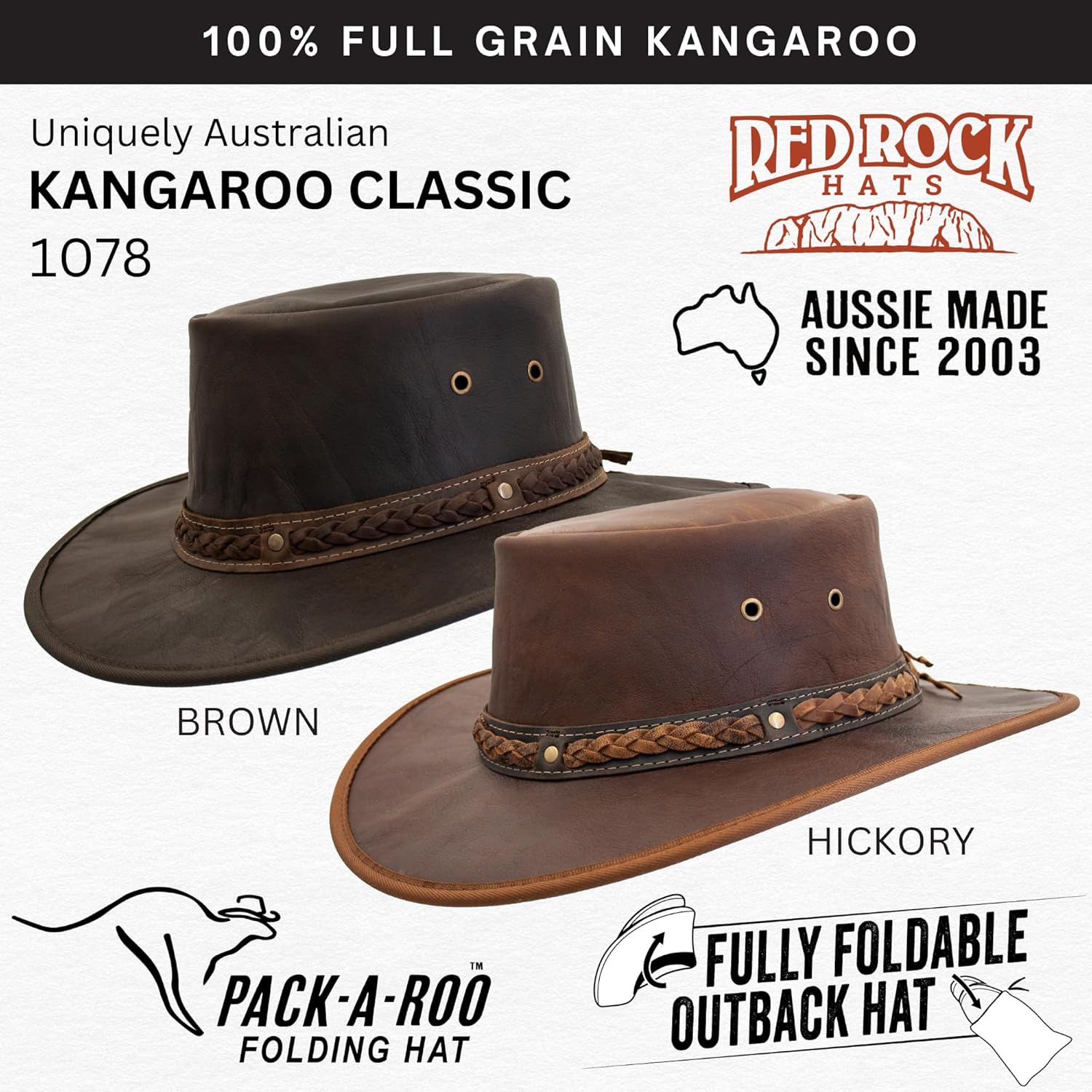
If you’re shopping for a leather outback hat — the kind with a wide, sun-blocking brim and a crown you can shape to suit your face — the single biggest decision you’ll face isn’t colour or brim width. It’s the hide underneath everything else. Kangaroo leather and full-grain cattle leather are the two materials you’ll see named most often in the premium end of this category, and they behave differently in ways that only become obvious after a season or two of real wear. Full-grain simply means the outermost, tightest layer of the hide has been kept intact — nothing has been sanded or buffed away — which makes it the most durable grade of cattle leather available. Kangaroo leather is a separate species entirely, with a fibre structure that published material science research consistently identifies as unusually dense for its weight. This article is a structured breakdown of what each material actually delivers over time, drawn from aggregated owner reports and published leather science — so you can make the call before you spend $150 to $400 on a hat you plan to wear for a decade.
| EDITOR'S PICK1078 Kangaroo Classic - Austral… | Mid-tierOztrala HAT Leather Australian… | Budget pickLeather Down Under HAT Aussie B… | |
|---|---|---|---|
| Material | Kangaroo leather | Leather | Leather |
| Made in AU | ✓ | — | — |
| Foldable | ✓ | — | — |
| Travel bag | ✓ | — | — |
| Finish | — | Oiled | — |
| Color | Hickory | Khaki | Brown/Black |
| Price | $125.00 | $69.90 | $47.99 |
| See on Amazon → | See on Amazon → | See on Amazon → |
What the Fibre Science Actually Says
Kangaroo hide has been studied in published tanning and materials literature — including analysis cited in Australian Geographic’s coverage of the Australian leather export industry — precisely because its tensile strength-to-weight ratio is exceptional. The collagen fibres run in a more uniform, parallel direction compared to cattle hide, which gives kangaroo leather a strength-to-thickness ratio that most tannery spec sheets put at roughly 10 times greater than comparable cattle hide at equivalent thickness. Smithsonian Magazine’s overview of leather science confirms that fibre bundle orientation is the primary mechanical driver of tear resistance in finished leather, which is why kangaroo has historically been the preferred material for footballs and equestrian goods where thin-and-tough is the brief.
For a hat, this translates into three things owners care about: shape retention under rain and pressure, resistance to crease-locking (the permanent fold a brim develops after being sat on or packed badly), and overall packability. Cattle full-grain — the good stuff, not corrected-grain or bonded leather — is genuinely excellent and has a longer tanning tradition, but it achieves its durability partly through thickness. A full-grain cattle hat brim holds shape because the leather is substantial; a kangaroo leather brim holds shape despite being thinner and lighter.
Neither material is categorically superior. The tradeoff is real: cattle full-grain ages into a deeper, richer patina that many owners actively want. Kangaroo leather, by contrast, tends toward a cleaner, tighter surface that shows less character variation over years. Which you prefer is an aesthetic judgement as much as a functional one.
What Long-Term Owners Actually Report
Across aggregated review data, the pattern between these two materials is consistent enough to draw some clear conclusions.
Owners of the Kangaroo Classic hat are among the most enthusiastic long-tenure reviewers in this entire category. Multiple buyers describe it as a “forever hat” — specifically in contexts where they had previously owned straw or canvas alternatives that warped out of shape. The recurring praise clusters around three points: the hat is noticeably lighter than they expected for a structured brim; it held its shape through rain without the felt-like softening that woven materials produce; and ventilation in midday sun was significantly better than they’d experienced with felt hats. One owner who describes trying “multiple straw hats that bent out of shape” before switching calls it definitively their final hat purchase. That’s the kind of long-game testimonial worth weighting.
The Full Grain Cooler draws a notably more candid review set. Owners consistently describe the leather itself as “supple and luxurious” — which tracks with what you’d expect from well-finished full-grain cattle hide. But a recurring construction complaint surfaces that deserves honest treatment: the sweatband attachment on some units uses hot glue rather than stitching, and several owners flag that this bond separates after regular wear. This is a legitimate quality-tier indicator, not a minor cosmetic issue. A glued interior band on a $150+ hat suggests the leather sourcing budget outpaced the construction budget — which is a known phenomenon in import-adjacent hat manufacturing. If you’re comparing two full-grain cattle hats, checking whether the band is stitched or adhered is worth your time before purchase.
The Australian Leather Cowboy Hat draws consistent praise for brim curvature and leather quality, but sizing inconsistency is a documented and recurring complaint. One buyer reported that the small was too tight and the medium too loose with no elastic or drawstring in the lining to compensate. For a leather hat with a rigid brim and no adjustment mechanism, half-size gaps between listed sizes are a genuine fit risk — not just a minor annoyance. The absence of a sizing shim or drawstring is an intentional construction choice that works when the sizing lands right and fails when it doesn’t. This is addressed in more detail in the FAQ below.
The American Hat Makers Hollywood oiled leather hat draws strong short-tenure reviews, with owners specifically mentioning visible craftsmanship and unsolicited compliments. The reviews are enthusiastic but generally shorter in ownership duration than the Kangaroo Classic reports, so there’s less data on how it behaves at the 3-5 year mark.
The Leather Down Under hat surfaces a packaging-as-quality-signal story worth noting: multiple owners report the hat arriving with the crown compressed inside a plastic bag rather than supported in box packaging. Crown compression during shipping isn’t always permanent, but it’s a reasonable proxy for how much care went into the product before it left the warehouse. By contrast, the Kangaroo range’s box-with-crown-support packaging is frequently mentioned by owners as a reassuring first impression — and in leather hat terms, arriving in shape matters because reshaping a compressed crown without steam and a hatter’s block is genuinely difficult.
By the Numbers
| Material | Relative weight (same brim area) | Typical patina development | Construction red flag to check |
|---|---|---|---|
| Kangaroo leather | Lighter | Minimal — stays cleaner looking | Band stitched vs. glued |
| Full-grain cattle | Heavier | Rich, character-building | Band stitched vs. glued; corrected-grain substitution |
Per published tannery spec comparisons and aggregated owner review patterns, not in-house testing.
The Honest Tradeoff Decision Frame
If you’re deciding between kangaroo and full-grain cattle leather for an outback-style hat, the decision comes down to four variables: weight priority, pack-and-travel use, patina preference, and construction quality at your budget tier.
If weight and packability are primary — you’re a long-haul traveller, a station worker who resents carry weight, or someone who frequently packs a hat in luggage — kangaroo leather’s fibre density-to-weight advantage is real and owner-verified. The Kangaroo Classic’s consistent shape-retention-in-rain reports suggest the material handles incidental stress better than heavier cattle hides at equivalent thickness.
If you want the leather to age visibly and beautifully over years — a patina-first buyer — full-grain cattle leather is the right aesthetic call. But construction quality matters enormously at this point: a glued interior band on a “premium” full-grain hat is a tell that the manufacturer cut corners somewhere in the build, and that kind of corner-cutting correlates with other durability compromises you won’t see on day one.
If you’re sizing a rigid leather hat without elastic adjustment, treat sizing as a risk factor, not a minor inconvenience. Measure your head circumference with a tailor’s tape (around the mid-forehead, above the ears, around the widest point of the back of the skull). If a brand’s size chart has gaps of more than 1cm between listed options and offers no drawstring or foam sizing insert, order knowing that returns may be necessary — and check the brand’s return policy before committing.
Frequently Asked Questions
Is kangaroo leather genuinely stronger and lighter than cattle leather, or is that just marketing?
The fibre science is real. Published materials research — including analysis cited in Heddels’ guide to leather grades and tanning methods — confirms that kangaroo hide has a collagen fibre structure that delivers high tensile strength at lower thickness. This isn’t marketing language; it’s why kangaroo leather has been used commercially in applications where weight and strength both matter. For hats specifically, owner reports of shape retention and rain resistance align with what the material science would predict. That said, excellent full-grain cattle leather is genuinely durable — the gap is most meaningful when weight, thickness, and packability are priorities.
Can a kangaroo leather hat be folded and packed in a suitcase without permanent damage?
Owner reports on the Kangaroo Classic specifically mention that the hat handles travel stress better than straw and canvas alternatives. However, no leather hat with a shaped brim is designed to be folded flat — the appropriate packing method is crown-down in a hat box or crown-supported in a bag with soft packing around the brim. Kangaroo leather’s recovery from incidental compression is notably better than cattle leather at equivalent thickness, but deliberate folding will crease the brim. If you need a hat that genuinely folds and recovers, an oilskin or wool-felt crushable is a better category entirely.
How often should a leather outback hat be conditioned, and what products do owners actually use?
Owner consensus across long-tenure reviews points to conditioning 2-4 times per year as a reasonable baseline for regular wear — more frequently if the hat is exposed to salt air, heavy sun, or wet conditions regularly. Products that appear most frequently in owner recommendations include beeswax-based leather conditioners and lanolin-based products, both of which are compatible with the tanning processes used in Australian-tanned hides. Avoid silicone-based sprays, which sit on the surface rather than penetrating the leather. Country Life UK’s guide to maintaining country leather goods recommends conditioning before storage as well as after wet weather — a reasonable rule for hat leather.
What does ‘Aussie Made’ mean on a kangaroo leather hat listing — where is it actually made?
This is genuinely variable and worth investigating per brand. Under Australian Consumer Law, “Australian Made” requires that the product be substantially transformed in Australia — but “Aussie Made” as a marketing phrase carries no regulated meaning. Some kangaroo leather hats use Australian-sourced and Australian-tanned hide but are assembled overseas; others are fully manufactured domestically. The Kangaroo Classic’s consistent owner enthusiasm includes references to Australian origin, but buyers wanting verified domestic manufacture should look for the official Australian Made certification logo on the product listing rather than relying on descriptive language alone.
How do you size a leather outback hat when the brand offers no elastic or drawstring adjustment?
Measure your head circumference precisely — a fabric tape measure, snug but not tight, around the widest point of your skull (typically just above the ears and across the mid-forehead). Compare this measurement to the brand’s size chart in centimetres, not just S/M/L labels, since size labelling is inconsistent across manufacturers. If your measurement falls between two sizes and the brand offers no adjustment mechanism, size up and use a hat sizing insert (a foam or leather strip available from hat retailers and milliners) to take up the difference. Sizing down into a rigid hat with no give risks a hat that causes headaches on long wear days and cannot be adjusted without professional stretching.
The core finding across all the owner data reviewed here is this: kangaroo leather earns its reputation for longevity and packability in verified, long-tenure use, while full-grain cattle leather earns its premium positioning on patina and substance — provided the construction underneath matches the material quality. The material in your hat matters less than whether the person who built it was paying attention to the whole hat, not just the hide.