August 9, 2026 • Callum Dray • 11 min reading time • Prices verified June 6, 2026
Oilskin Versus Leather for Hard Outdoor Use: Which Australian-Style Hat Survives the Long Haul
If you’re shopping for an outback-style hat that will genuinely hold up through years of hard outdoor use — not just weekend hikes, but station work, long-haul travel, horseback riding, or job-site exposure — you’ll hit the same fork in the road quickly: oilskin or oiled leather. Oilskin, in this context, means a woven fabric (usually cotton or poly-cotton) saturated with a wax or oil compound to make it water-resistant — the same principle behind a classic Drover-style coat. Oiled leather is exactly what it sounds like: full-grain animal hide treated with oils and waxes to condition and weatherproof it. Both materials have genuine credibility in the Australian bush-hat tradition. Both can last a decade with the right care. But they behave very differently in heat, rain, tight packing situations, and maintenance routines — and the wrong choice for your conditions can mean a miserable hat by year two. This article draws on owner reviews across multiple years of use, published material guides, and editorial reporting to name those tradeoffs plainly, so you can match material to mission.
What the Long-Term Owner Record Actually Says
The most useful data point for any serious hat buyer isn’t the product description — it’s the five-year owner. And in the oilskin category, the OTC River Guide has earned one of the most credible long-haul endorsements in the current review record. A five-year owner reports oiling the hat annually and taking it through camping, hiking, and job-site conditions, with the hat still looking, in their words, “as pictured.” That’s a meaningful benchmark. Five years of varied outdoor use with one maintenance action per year — and the hat held its form and finish.
That single data point tells you something structural: oilskin, properly maintained, rewards low-intervention ownership. You don’t need to fuss with it between seasons. You oil it once a year, let it breathe, and it comes back. Writing in Heddels, “The Complete Guide to Waxed Canvas,” editors explain the underlying mechanism — the oil compounds in oilskin fabric continue to condition the fibres with each application, gradually building a patina that actually improves water-shedding performance over time, not unlike the seasoning effect on well-used cast iron or leather.
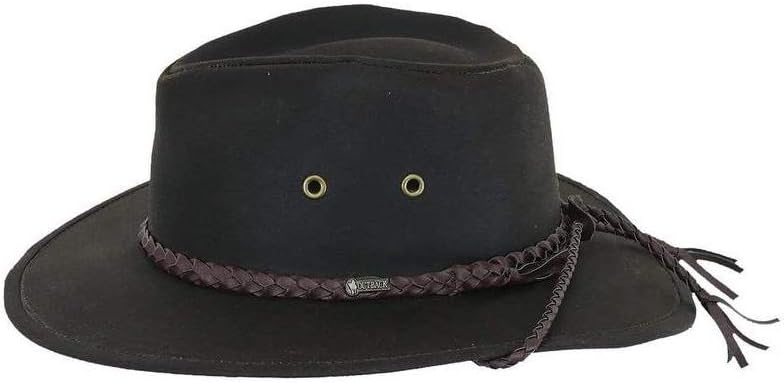
The OTC Grizzly adds a different dimension to the oilskin picture. Reviewers consistently praise its brim shapability — the ability to bend and set the brim to your preferred angle, whether that’s a cattleman’s wide flat brim or a tighter front snap. One owner described it paying for itself on its first day in a snowstorm. That’s real-world proof of concept. But the Grizzly also surfaces an important caveat that any oilskin buyer needs to hear: sizing runs large. One owner received an XL that, in their own description, “wobbles when I walk.” In a hat you’re wearing through wind and physical work, a loose fit is not a minor inconvenience — it’s a liability. Sizing solutions are addressed in the FAQ section below.
On the leather side, American Hat Makers Hollywood owners are notably enthusiastic — the visible craftsmanship, the compliments, the feel of the hat — but a pattern worth naming honestly is that these reviews are shorter-tenure than the oilskin five-year reports. You’re reading enthusiasm from owners who’ve had the hat one or two seasons, not five. That’s not a strike against the product; it’s an evidence gap. The hat may well hold up beautifully. But right now, the published owner record doesn’t yet tell us what year four or five looks like.
Oztrala oiled leather presents a similar situation. Owners praise fit and leather quality, sometimes with real conviction. But multi-year durability data in the published review record is thin. If you’re making a decision based on documented long-haul performance, the oilskin category currently has the stronger evidence base — specifically the River Guide’s five-year benchmark.
The Breathability Problem Nobody Advertises
Here’s the tradeoff that oilskin manufacturers don’t put in the headline: oilskin retains heat. It’s not a defect — it’s physics. The same oil-saturated weave that repels water also limits airflow through the crown and brim. Across the OTC product review record, multiple owners note heat retention as the known cost of waterproofing. In a cold-weather downpour or a snowstorm, oilskin is genuinely excellent. In a 35°C Australian summer with full sun and no breeze, it is a different experience entirely.
Oiled leather, by contrast, allows slightly more airflow through natural variations in the hide’s grain — but “slightly” is doing real work in that sentence. Neither material is a ventilated performance hat. If your primary use case is extreme heat and high-UV sun coverage with ventilation as a priority, both materials have limitations. Writing in Country Life, “Why Oilskin Never Really Went Away,” editorial staff covering outdoor working gear make this point directly: oilskin excels in wet-cold conditions and loses its advantage meaningfully in dry heat. The honest answer for extreme heat may involve looking at wool-felt or fur-felt constructions with ventilated eyelets instead.
Head-to-Head: Three Buyer Profiles Compared
To make the oilskin-versus-leather decision concrete, it helps to anchor it in three realistic buyer profiles. Each represents a distinct set of conditions and priorities — and each points toward a different answer.
The Station Worker or Agricultural User
For someone doing genuine outdoor labour — fencing, mustering, or extended field work in variable weather — sustained rain protection and durability over years (not seasons) are the governing priorities. The OTC River Guide is the benchmark product here, supported by its five-year owner record.
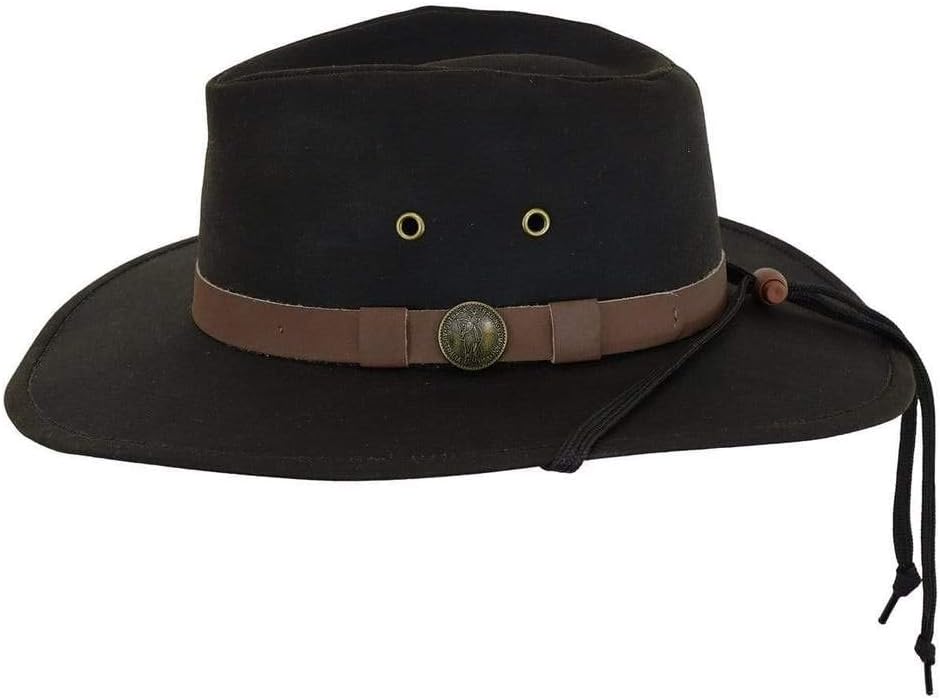
The station worker’s case for oilskin is strong: it provides documented waterproofing under heavy rain, it responds well to annual maintenance, and it holds structural integrity through physical use. The heat-retention limitation is real but manageable — a hat worn in the full sun during the dry season will be warm, and the owner should know that going in. Outside Online, “How to Choose the Right Hat for Every Outdoor Adventure,” identifies sustained waterproofing as the single most important feature for workers exposed to unpredictable weather patterns, which maps directly to the oilskin advantage.
Verdict for this profile: Oilskin. The River Guide’s documented longevity record is the evidence base that agricultural users need before committing.
Outback
$79.99
In stock on Amazon
Check price on AmazonThe Long-Haul Traveller or Expedition Rider
For someone covering serious ground — extended horseback travel, multi-country road trips, international expeditions — packability and adaptability become as important as weather protection. A hat that can’t survive being transported without a dedicated hat box is a liability.
Oiled leather earns genuine consideration here. Leather develops memory over time, gradually conforming to the wearer’s head and returning to that shape after transport. A well-broken-in leather hat handles casual packing better than a stiffened oilskin equivalent, because the leather’s natural flexibility absorbs compression without taking a permanent set. Outside Online, “How to Choose the Right Hat for Every Outdoor Adventure,” notes this distinction between rigid waterproof constructions and flexible leather options as a key differentiator for expedition contexts — the flexibility that makes oilskin structurally reliable in heavy rain is the same rigidity that makes it awkward to pack. The American Hat Makers Hollywood is the representative product in this category, with owners praising fit and finish.
The traveller accepting a leather hat should understand they are accepting water resistance, not waterproofing. A shower, light drizzle, or a brief downpour: handled. Sustained heavy rain on a long ride: penetration is likely without additional seam treatment.
Verdict for this profile: Oiled leather, with realistic expectations about rain performance.

American
$139.00
In stock on Amazon
Check price on AmazonThe Weekend Outdoor Enthusiast Prioritising Value and Evidence
For a buyer who heads out regularly but not professionally — weekend hiking, camping, occasional horseback outings — and who wants the best-documented long-haul value for the investment, the calculus currently favours oilskin based on the published owner record. The OTC Grizzly offers the brim-shapability and all-weather performance that multi-use owners want, with the caveat that sizing requires attention: this hat runs large, and buying without measuring against the published size chart risks the wobble-when-walking problem that one owner described with a too-large XL.
For this buyer, the Grizzly’s combination of shapable brim, oilskin waterproofing, and a proven maintenance routine (annual re-oiling with Nikwax Wax Cotton Proof or Otter Wax) represents the most evidence-supported choice in the under-three-hundred-dollar category. Leather alternatives like Oztrala oiled leather are appealing, but the shorter tenure of available owner reviews means the data isn’t yet there to confirm equivalent longevity.
Verdict for this profile: Oilskin — specifically the OTC Grizzly, sized down if between sizes.
Outback
$74.99
In stock on Amazon
Check price on AmazonMaterial Tradeoff Summary
| Factor | Oilskin | Oiled Leather |
|---|---|---|
| Waterproofing (heavy rain) | Strong — when re-oiled annually | Moderate — water resistance, not full waterproofing |
| Breathability | Low — heat retention is consistent owner complaint | Slightly better, still limited |
| Long-haul evidence (5+ yr) | Documented (OTC River Guide benchmark) | Thin — shorter-tenure reviews dominate |
| Packability | Moderate — rigid construction risks crease under pressure | Good — leather softens and returns to shape |
| Sizing predictability | Lower — OTC Grizzly runs large; size down | Generally true to size |
Maintenance Reality: What Experienced Owners Actually Do
The OTC River Guide’s five-year owner oils annually. That cadence maps closely to what experienced oilskin owners across the published review record report as their actual practice. Not every month, not every season. Once a year, or when the fabric starts to look dry or loses its beaded water-shedding behaviour — the moment when rain stops beading on the surface and starts soaking in rather than running off.
Owners most commonly report using specialist oilskin reproofing waxes. Nikwax Wax Cotton Proof and Otter Wax are the products named most frequently, applied with a cloth and worked in with light heat from the hands or a low-heat hair dryer to help the wax penetrate evenly. The process takes fifteen to twenty minutes and is genuinely low-effort once you’ve done it once.
For oiled leather, the maintenance cadence reported by owners is broadly similar — annual conditioning — but the product choices differ. Leather-specific conditioners such as neatsfoot oil or leather balm products feed the hide and help maintain water resistance. The distinction worth making explicitly: oiled leather provides genuine water resistance in light to moderate rain, but it is not the same as oilskin waterproofing under sustained heavy rain.
Writing in Smithsonian Magazine, “The Science of Waterproofing Historic Fabrics,” researchers examining the history of oil-treated materials draw this distinction clearly — oil-treated natural leather was always a weather-resistant material, not a waterproof one in the modern technical-fabric sense. If you work in sustained rainfall, oilskin is the more protective choice. If you encounter incidental rain and want a hat that handles a shower without drama, oiled leather is adequate.
Australian Geographic, “Icons of the Outback: The Bush Hat’s Long Story,” notes that brim shaping was historically done by working drovers as a matter of course, adapting hats to personal preference in the field — and this remains true for oilskin today. Oilskin brims can be repositioned using gentle, even heat, softening the wax compound enough to allow reshaping before it re-sets on cooling.
Frequently Asked Questions
Can an oilskin hat be reshaped once it arrives with the wrong brim set? Yes, with patience. Oilskin brims can be repositioned using gentle, even heat — a low-heat hair dryer applied slowly while you hold the brim in the desired position. The wax compound softens enough to allow reshaping, then re-sets as it cools. Gradual heat is the key; prolonged or direct high heat can damage the fabric weave.
How often do experienced oilskin hat owners actually re-oil, and what do they use? Based on the published owner record, the practical answer is once a year, or when water stops beading on the surface. Nikwax Wax Cotton Proof and Otter Wax are the most frequently cited products. Application is typically done by hand — working the product into the fabric with warmth from your palms — followed by a light pass with a low-heat dryer to help the wax penetrate.
Does oiled leather provide genuine waterproofing or just water resistance in light rain? Water resistance in light to moderate rain is the accurate description. Oiled leather repels incidental moisture effectively — a shower, light drizzle, brief downpour — but sustained heavy rain will eventually penetrate. If waterproofing is your functional priority, oilskin is the more reliable choice.
Is the OTC Kodiak too rigid to pack in a suitcase or saddle bag? Too rigid for casual compression packing, yes. The Kodiak’s structured construction holds its shape well in use but doesn’t recover reliably from being forced into tight spaces under sustained pressure. It travels well in a hat box or structured bag. Plan for that, or choose a more flexible alternative if compression packing is a regular requirement.
Which material is better for hot-weather use when both sun coverage and ventilation matter? Neither excels, but oiled leather has a slight edge on breathability. The oilskin heat-retention complaint is consistent enough across owner reviews to treat as a real limitation in high-temperature conditions. For extreme heat where ventilation genuinely matters, both materials fall short of ventilated wool-felt or fur-felt constructions with eyelets — and that’s worth knowing before you invest in either.