August 28, 2026 • Callum Dray • 11 min reading time • Prices verified June 6, 2026
Oilskin Hat Buyer's Comparison: Outback Trading Company's Range Head to Head
If you’ve spent any time looking at waterproof bush hats, you’ve probably come across the term oilskin — a fabric coated with oil-based compounds to repel water. Unlike a fur-felt hat that sheds light rain through tight fibre density, an oilskin hat (sometimes called a waxed-cotton hat) relies on its surface treatment to keep you dry. That coating is a consumable: it works brilliantly when fresh, degrades with sun and abrasion over time, and needs to be periodically renewed. Outback Trading Company, a US-based brand that leans heavily into Australian drover and bush aesthetics, has built one of the most recognisable ranges of oilskin hats in the mid-tier market. Models like the River Guide, Grizzly, Bootlegger, Kodiak Mesh, and Canyonland sit in a price band that draws serious outdoor buyers, working-ranch wearers, and style-conscious travellers alike. This article maps the real tradeoffs across those models so you can match the right hat to how you actually use it.
| EDITOR'S PICKOutback Trading Company Men's 1… | Mid-tierOutback Trading Company Unisex… | Budget pickOutback Trading Company Unisex… | |
|---|---|---|---|
| Model | 1484 Bootlegger | 1486 Grizzly | 1472 Kodiak |
| UPF rating | UPF 50 | UPF 50 | — |
| Ventilation | — | — | Mesh |
| Size given | Large | Large | X-Large |
| Price | $79.99 | $79.99 | $74.99 |
| See on Amazon → | See on Amazon → | See on Amazon → |
What Oilskin Construction Actually Means for These Hats
Before comparing models, it’s worth being clear about what oilskin construction locks in and what it doesn’t. Heddels’ workwear and heritage materials reference explains that waxed and oilskin fabrics achieve their water resistance through a continuous surface film rather than the fibre weave itself — which has two important downstream consequences for hat buyers.
First, the brim is stiffer and less forgiving than felt or canvas. That stiffness is partly structural (the cotton substrate) and partly the coating setting into shape over time. This is good news for sun coverage — the brim holds its geometry through a full day’s outdoor work without flopping — but it means reshaping is a deliberate act, not something that happens incidentally from wear.
Second, oilskin hats cannot be steamed, blocked, or stretched the way a fur-felt hat can. If you order the wrong size on a felt hat, a hatter can often work with you. If you order the wrong size in oilskin, you’re generally working with what you have. This point matters enormously when we get to the Grizzly.
Country Life’s rural gear editorial notes that waxed-cotton outerwear across all categories — coats, hats, bags — rewards owners who treat maintenance as a seasonal ritual rather than an emergency repair. The same logic applies here: re-oiling on a schedule keeps the waterproofing continuous; letting it lapse until you notice leaking means you’ve already had a few wet-head days you didn’t need to have.
Model-by-Model: Where Each Hat Sits in the Range
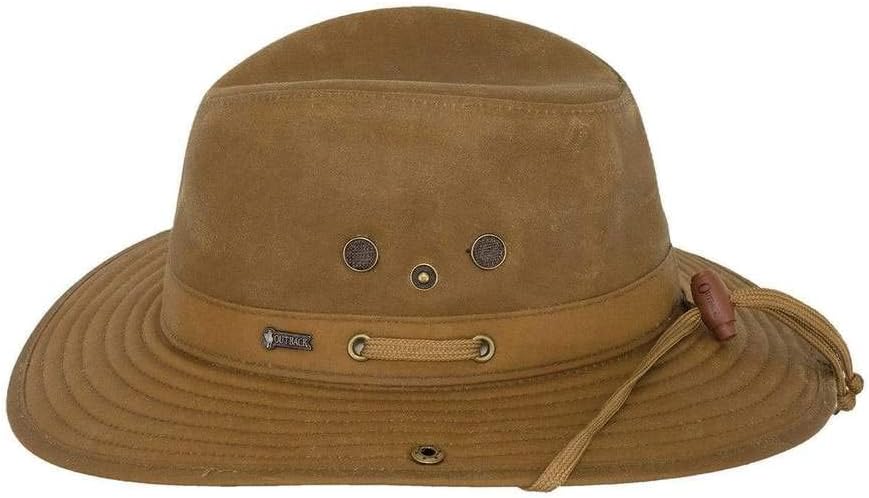
River Guide — The Long-Haul Benchmark
Owner reports gathered across aggregated retail reviews consistently position the River Guide as the range’s most field-tested model over time. One reviewer with documented five-year ownership describes a reliable annual re-oiling rhythm — retreating the hat once per year — as the specific maintenance practice that has kept waterproofing intact across multiple seasons. That’s a useful data point: not “re-oil when it leaks” but “re-oil on a calendar, before it leaks.”
The River Guide’s brim geometry runs wide and relatively flat, with moderate taper — a functional drover profile rather than a fashion silhouette. Outside Online’s gear coverage of wide-brim sun hats consistently flags full-brim coverage (rather than a cowboy-style back roll) as the meaningful variable for UV protection in open-terrain use, and the River Guide’s shape satisfies that criterion according to the brand’s published product specifications.
The River Guide is the documented long-haul choice for buyers who want a workhorse model and are willing to maintain it on a schedule. Its combination of proven owner longevity data and conservative brim geometry makes it the clearest recommendation in the range for multi-season outdoor work.
Outback
$79.99
In stock on Amazon
Check price on AmazonGrizzly — The Sizing Problem You Need to Know About
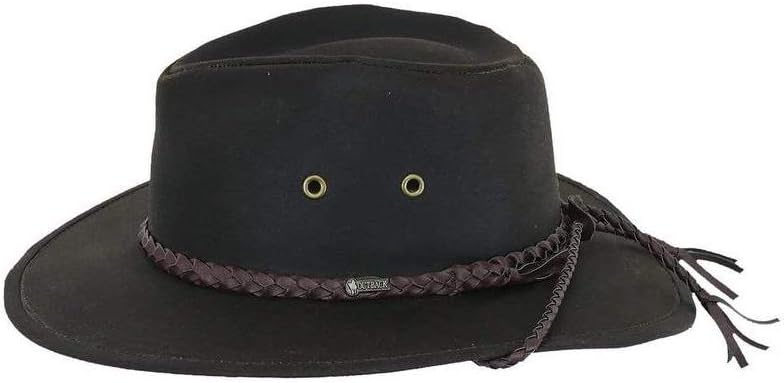
The Grizzly is, by published specification, one of the more substantial offerings in the range — broader brim, heavier build, clearly positioned as a serious weather hat. But there is a documented sizing issue you should factor in before ordering.
At least one detailed owner review records ordering XL based on the published Outback Trading Company size chart and receiving a hat that wobbles noticeably when walking — a fit problem significant enough that the reviewer flags it as a structural concern, not just a comfort nuisance. Here’s why that matters more for oilskin than for other hat categories: you cannot stretch oilskin over a hat block, and steam reforming is off the table. The usual felt-hat correction paths do not apply. If the Grizzly arrives too large, your options are sweatband layering (which can recover about half a size) or returning it.
The practical implication: order down from the size chart on the Grizzly. If you measure as an XL, start with L and check the fit before committing. Reviewers who have had good Grizzly experiences tend to note the crown fit is snug rather than generous — that is what you want in an oilskin that will be worn in moving-air conditions.
For buyers who want maximum flat brim coverage and are willing to navigate the sizing caveat carefully, the Grizzly remains the most substantial weather-blocking option in the range.
Outback
$79.99
In stock on Amazon
Check price on AmazonBootlegger — The Care-Investment Hat
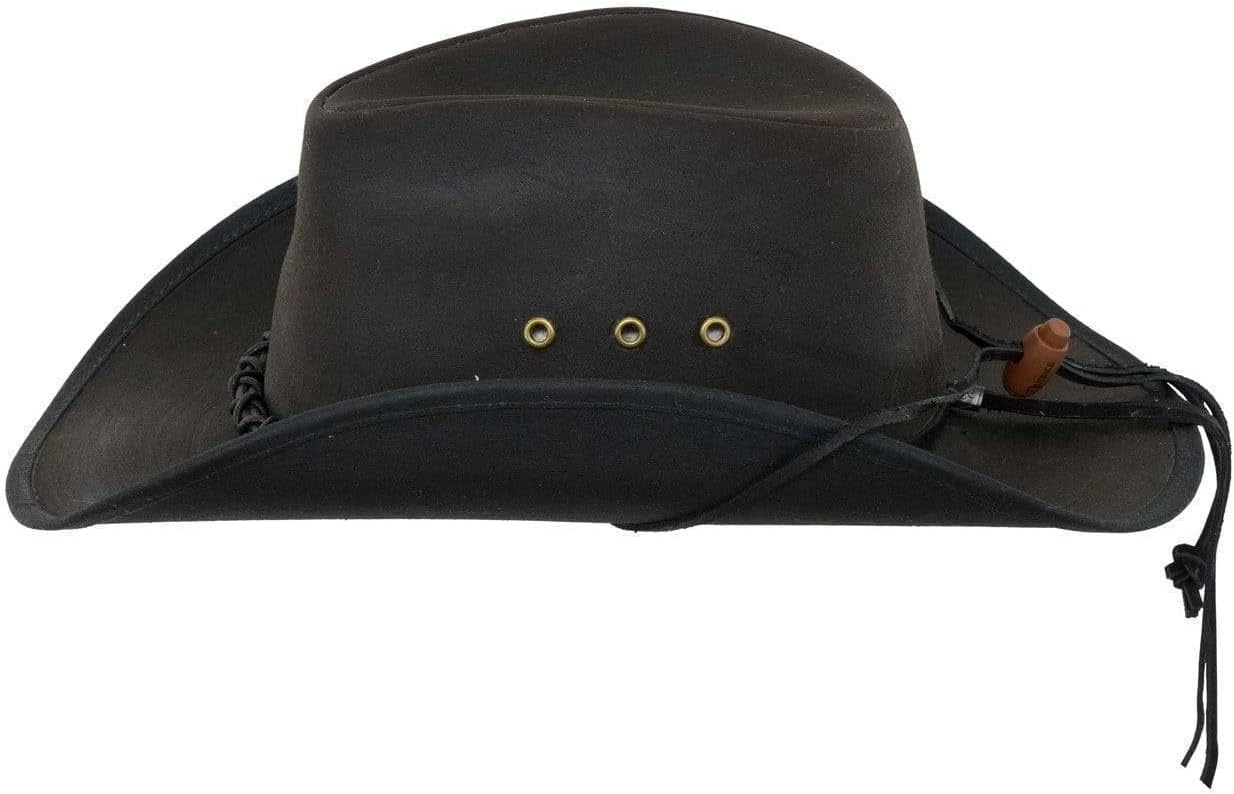
The Bootlegger draws a distinctively personal style of review from its owners. One multi-paragraph owner account frames the hat-buying decision as analogous to choosing a car — a considered investment that pays returns proportional to how much attention you give it — and ultimately lands on the Bootlegger as a hat that rewards that attention. The brim has a more pronounced drover-style roll than the Grizzly’s flatter geometry, which translates to a slightly more directional weather-shedding profile: it moves rain off to the sides efficiently, but the front brim is your primary sun and rain shield.
Brim stiffness on the Bootlegger, per aggregated owner reports, sits slightly higher than the Grizzly. The rolled profile holds its shape firmly and resists casual reshaping. That is a feature if you want a consistent silhouette day after day; it is a constraint if you like to pinch and shape your brim situationally the way a felt hat wearer might fold the brim up on one side in a headwind.
Grizzly vs. Bootlegger decision frame: If flat, maximised brim coverage is your priority — wide-open rangeland or on-water use — the Grizzly’s geometry serves better, sizing caveat noted. If you want a more structured drover silhouette with strong lateral rain-shedding and don’t mind a stiffer brim, the Bootlegger is the cleaner choice.
Outback
$79.99
In stock on Amazon
Check price on AmazonKodiak Mesh — The Airflow Tradeoff
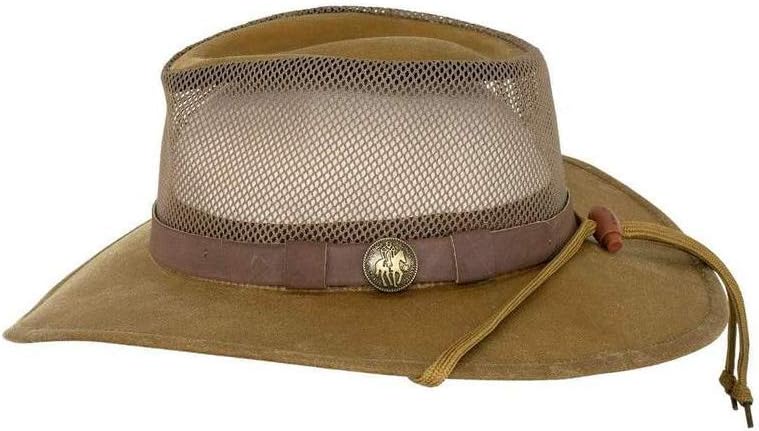
The Kodiak Mesh variant addresses the fundamental problem with oilskin in warm-to-hot climates: waxed cotton does not breathe. The mesh panel — typically positioned around the crown sides — allows air circulation that owners with high heat-sensitivity (including at least one reviewer who explicitly mentions head-cooling as a priority) rate as genuinely transformative.
The honest caveat, which that same reviewer acknowledges directly: mesh panels cannot be waterproofed. The oilskin treatment on the brim and crown top will shed rain, but water coming at the hat from an angle — or driven sideways in wind — can reach your head through the mesh. Australian Geographic’s outdoors coverage on hot-climate sun protection consistently notes that the UV-blocking benefit of a wide-brim hat is structural (shade geometry) rather than material-dependent, so for high-UV environments where rain is intermittent, the Kodiak Mesh is a reasonable tradeoff. For extended rain exposure, it is not.
Outback
$79.99
In stock on Amazon
Check price on AmazonCanyonland — The Shapeable Entry Point
The Canyonland draws buyers who are transitioning from military-style boonie hats — soft, all-around-brimmed hats with a floppy profile and minimal structure — and discovering that a brim with actual structure makes a meaningful functional difference. At least one documented owner comparison makes this transition explicit, praising the Canyonland’s brim as shapeable to personal preference while still holding the adjusted shape — a quality that boonie hats, by design, lack.
The Canyonland sits at the lighter, more packable end of the Outback Trading range. The brim can be manipulated by hand — front edge up for visibility, side rolled for rain-shedding — and owners report the oilskin fabric holds the adjusted shape reasonably well once set. It is not the permanence you would get from blocking a felt hat, but it is a meaningful step above floppy canvas.
Outback
$74.99
In stock on Amazon
Check price on AmazonRange at a Glance
| Model | Brim Character | Waterproofing | Travel/Pack? | Sizing Risk | Tier |
|---|---|---|---|---|---|
| River Guide | Wide, flat drover | Full oilskin | Moderate | Low | Outback — $79.99 |
| Grizzly | Wide, flat, heavy | Full oilskin | Low | High — order down | Outback — $79.99 |
| Bootlegger | Rolled drover | Full oilskin | Low | Moderate | Outback — $79.99 |
| Kodiak Mesh | Wide + mesh crown | Partial (brim only) | Moderate | Low | Outback — $79.99 |
| Canyonland | Shapeable, lighter | Full oilskin | Higher | Low | Outback — $74.99 |
Ratings based on aggregated owner reports and published product specifications from Outback Trading Company.
Frequently Asked Questions
How often do you need to re-oil an Outback Trading Company oilskin hat to maintain waterproofing?
The most reliable owner testimony — from a documented five-year River Guide owner — points to a once-per-year re-oiling schedule as the maintenance rhythm that keeps waterproofing continuous. The practical principle: don’t wait until you notice leaking. By then, the coating has already degraded enough that you’ve had unnecessary wet-head experiences. Treat it like a seasonal task — once before the wet season, or once before winter, depending on your climate.
Why does the size chart sometimes produce a hat that is too large, and how should buyers compensate?
At least one detailed Grizzly review documents ordering XL per the published size chart and receiving a hat with a loose, wobbling fit. The likely cause is that oilskin brims and structured crowns don’t compress inward the way a soft hat does when slightly large — there is no give, so even a half-size excess is immediately noticeable. Compensate by ordering one size down from your chart measurement, particularly on the Grizzly. Sweatband layering can recover about half a size if needed.
Which models in the range are most packable for travel?
None of the oilskin models are truly crushable — the waxed coating will crease and potentially crack if packed tightly. The Canyonland, being lighter and more flexible, tolerates careful packing better than the Grizzly or Bootlegger. If packability is your primary requirement, an oilskin hat in any configuration is a compromise; a quality wool-felt or canvas option will serve better.
Does the mesh panel on the Kodiak Mesh mean rain gets through to your head?
Yes — the mesh panels do not hold an oilskin coating and will allow water ingress from wind-driven or angled rain. The oilskin treatment on the brim and top crown sheds direct downward rain effectively, but the Kodiak Mesh should not be treated as a fully waterproof hat. It is an airflow-optimised option that accepts a weather-resistance tradeoff, which its own reviewers acknowledge openly.
Can the brim on these oilskin hats be reshaped, and will it hold?
The Canyonland’s lighter, more flexible brim can be hand-shaped and will hold a set position reasonably well. The Bootlegger’s rolled brim is stiffer and more resistant to casual reshaping. The Grizzly’s flat brim is similarly resistant. None of these should be steamed or heat-shaped; oilskin coatings can be damaged by direct heat, and unlike fur felt, they will not recover their shape afterward.
How does the Grizzly compare to the Bootlegger for brim stiffness and weather-shedding?
The Bootlegger has a stiffer brim with a more pronounced lateral roll, which channels rain efficiently to the sides. The Grizzly’s flatter, wider brim provides more even coverage overhead but is slightly less aggressive at directional shedding. For stationary or slow-moving use in heavy rain — fishing, station work — the Grizzly’s coverage profile is an asset. For moving use in sideways rain or wind, the Bootlegger’s rolled geometry performs better. The sizing caveat on the Grizzly remains the more important variable for most buyers.
The Decision Frame
If your priority is proven multi-season durability and you will commit to annual maintenance → River Guide is the documented long-haul choice.
If you want maximum brim coverage and are willing to order down a size and verify fit → Grizzly, with the explicit note to treat the size chart as a starting point rather than a final answer.
If you want a structured drover silhouette, don’t mind a stiff brim, and value consistent shape over adjustability → Bootlegger.
If you are in high heat and willing to trade full waterproofing for airflow → Kodiak Mesh, with clear eyes on its rain-resistance limits.
If you are coming from a soft-brim boonie or canvas hat and want a shapeable step up with more structure → Canyonland is the most accessible entry point in the range.
The through-line across all models: oilskin rewards owners who treat it as a maintained piece of kit rather than a set-and-forget purchase. Country Life’s rural gear editorial makes exactly this point about waxed-cotton outerwear broadly — the category performs best for people who build maintenance into a seasonal routine. The River Guide’s five-year track record isn’t luck. It’s a calendar reminder.