August 6, 2026 • Callum Dray • 12 min reading time • Prices verified June 6, 2026
Wool Felt Outback Hats From Budget to Mid-Range: What Five Years of Wear Reveals
If you are new to the world of outback hats, here is the one thing worth knowing before anything else: not all felt is the same. Wool felt — made by matting and compressing wool fibres under heat and pressure — is the most common material in the $50–$180 hat market, and it sits a clear step below fur felt (the premium grade used in heritage Akubras, where rabbit or hare fur is processed the same way but produces a denser, finer, and longer-lived result). Wool felt hats are not lesser products, but they are a different proposition: they trade some of that multi-decade lifespan for a lower entry price, a softer hand, and — in the best examples — a remarkable ability to be crushed, rolled, rained on, and shoved under a truck seat before bouncing back. This article works through what five years of aggregated owner reports and published construction detail actually reveal about which wool felt outback hats earn their keep, which ones quietly disappoint, and what tradeoffs you are accepting at each price point.
| EDITOR'S PICKStetson Hawk Wool Crushable Out… | Mid-tierOztrala】Australian Wool Felt HA… | Budget pickScala Classico Men's Crushable… | |
|---|---|---|---|
| Material | Wool | Wool felt | Felt |
| Crushable | ✓ | — | ✓ |
| Crown style | Cowboy | Outback | Outback |
| Band | — | Leather | — |
| Sizes | Small | US X-Large | X-Large |
| Color | Black | Sand | Chocolate |
| Price | $144.99 | $95.90 | $79.99 |
| See on Amazon → | See on Amazon → | See on Amazon → |
The Shape-Recovery Question: What Owners Actually Report
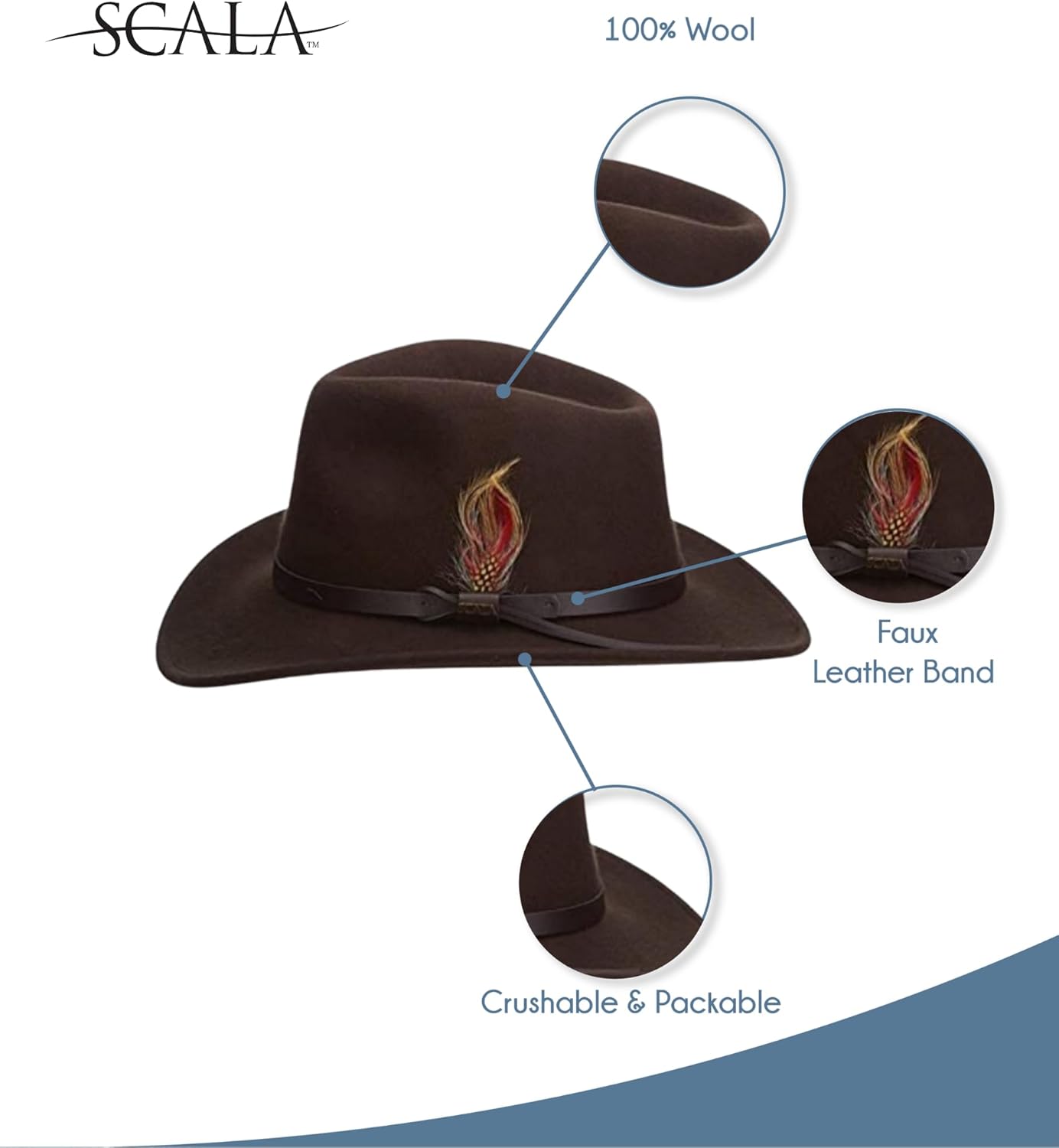
The single most contested claim in wool felt marketing is crushability — the idea that you can sit on this hat, stuff it in a bag, and shake it back to round. It sounds like a selling line, but across aggregated reviews of the Scala Classico, it turns out to be largely true in practice. Owners consistently describe surviving daily commuter abuse: hats retrieved from under stadium seats, pulled from the bottom of duffel bags, even sat on repeatedly in truck cabs, recovering with nothing more than a light reshaping by hand. The pattern across several hundred reviews is striking in its consistency — the crown springs back without permanent creasing, and the brim retains its set curl.
This is not magic; it is a construction decision. Writing in their piece “How Felt Hats Are Made” (Heddels, heddels.com), the editors explain that wool felt’s recovery behaviour depends heavily on two variables: the density of the felt blank — how tightly the fibres are compressed before the hat is blocked into shape — and whether the brim has been stiffened with a wire or resin edge. The Scala Classico, per its published spec and owner reports, uses a moderately dense felt without aggressive brim stiffening, which is exactly why it crushes and recovers rather than cracking or holding a crease. The tradeoff is that it will not hold as precise a brim geometry as a stiffened hat; owners who want a razor-sharp pencil curl will find it drifts slightly in heat and humidity.
The B&S Premium Lewis tells a more demanding story. Owner reports from farm and station environments — heavy daily sweat, animal contact, repeated wetting and drying — consistently describe structural integrity beyond twelve months with no failure of the crown seam or brim binding. For a hat in its price tier, that is a standout data point. The felt blank appears denser than the Scala’s, which gives the Lewis slightly less crush-and-recover bounce but meaningfully more resistance to the kind of sustained mechanical stress that destroys cheaper wool felt within a season.
Brim Softness, Rain Performance, and the Mid-Range Trade-Off
If there is one area where the wool felt category genuinely confuses buyers, it is brim softness variation. A hat’s brim can range from board-stiff (typical of shellac-finished straws and some stiffened fur felts) to almost fabric-limp (common in entry-level crushable wool felts). Within the $80–$150 tier that range spans most of its width, and it matters because brim stiffness directly controls two things: sun coverage geometry (a soft brim droops, narrowing effective shade) and rain shedding (a limp brim dumps water inward rather than channelling it away from the face).
As Heddels notes in “How Felt Hats Are Made,” brim stiffness in a felt hat is controlled by felt density, brim width, and finishing treatments such as shellac sizing or a stitched wire brim edge — makers targeting crushability deliberately use softer, lighter felt and avoid wire edges, which is why the same “wool felt outback hat” label can describe everything from a near-rigid brim to one that droops noticeably in humidity.
Bigalli: Fit Precision, Soft Brim
Bigalli buyers sit in an interesting position. Multiple reviewers note a “brim a little soft” observation — not a structural complaint, but a fit-and-function note that the brim requires deliberate management in wind and heavy rain. What makes this data point worth taking seriously is who is saying it: across aggregated Bigalli reviews, a meaningful proportion of buyers mention having returned or discarded several previous hats before settling on Bigalli, which suggests an experienced, discerning audience whose brim softness observation is not naivety about the category. Bigalli owners simultaneously praise fit precision and packaging quality — the latter a reasonable proxy for a maker who thinks carefully about how the hat arrives — which points to a brand doing most things right but making a deliberate softness call on the brim.
Oztrala】Australian
$95.90
In stock on Amazon
Check price on AmazonStetson Hawk: Cool-Climate Performance, Summer Limitation
The Stetson Hawk draws buyers who are explicitly seeking Stetson construction credibility without a $300-plus outlay, and owner reports confirm two things reliably: warmth and rain performance above expectation for the price, and a clear summer limitation. The Hawk runs warm — owners in cool-climate and shoulder-season use report genuine satisfaction, but multiple reviewers flag it directly as too hot for Australian summer conditions. This is a brim-and-felt-weight story: the Hawk’s brim holds its geometry better than the Scala in wet conditions (owners confirm respectable rain shedding), but the felt weight that enables that performance also traps heat. The honest read on whether the Hawk delivers the same quality as higher-grade Stetsons is: no, but that is not what it is for. It is a well-built seasonal hat for cold and wet conditions, not an all-rounder.
Oztrala】Australian
$95.90
In stock on Amazon
Check price on AmazonOztrala: Thin Long-Run Data
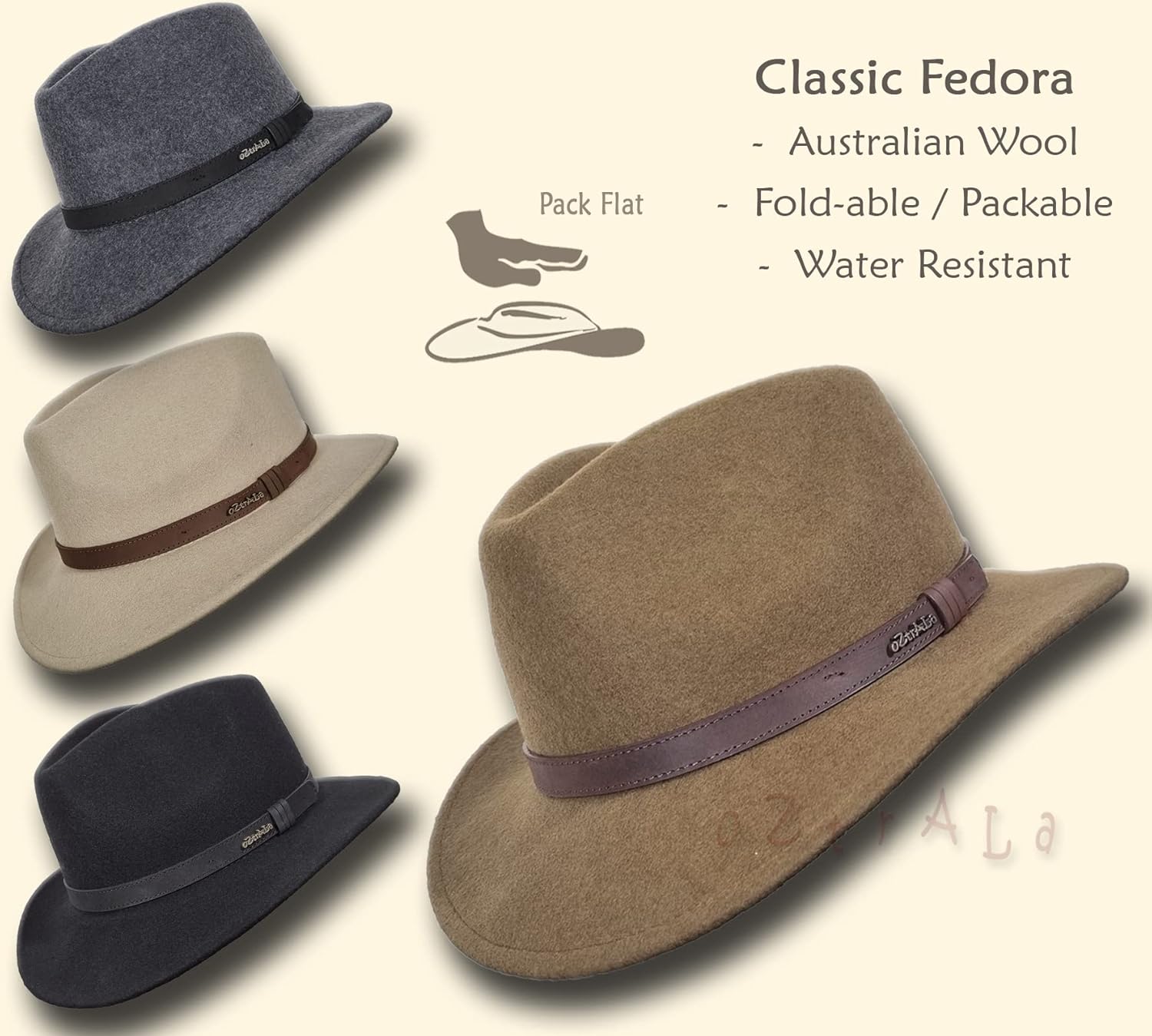
Oztrala presents a transparency challenge worth naming directly. The brand appears regularly in outback hat searches and its pricing sits in the accessible mid-range, but aggregated owner reviews are notably thin on specific construction detail — felt density, brim binding method, crown stiffening approach. What exists is mostly positive on aesthetics and initial shape, but the absence of long-run wear reports (three years plus, hard use) is itself a data point. It does not mean the product fails; it may simply mean the brand’s review base skews toward infrequent wearers or is still accumulating longitudinal data. For a buyer whose hat needs to earn its keep under station conditions, the Lewis and Scala have the review depth to justify confidence; Oztrala asks you to accept more uncertainty.
Scala
$79.99
In stock on Amazon
Check price on AmazonConstruction Fundamentals: What the Research Says
Understanding why these hats behave differently under pressure requires a brief look at how wool felt is made. The Heddels editorial team, in “How Felt Hats Are Made” (Heddels, heddels.com), describes the process in useful detail: raw wool fibres are carded, layered, and subjected to heat, moisture, and mechanical pressure until the fibre scales interlock permanently — a process called fulling. The resulting felt blank is then blocked, meaning it is stretched over a wooden form while wet to set the crown shape and brim width. The density achieved during fulling and the precision of the blocking process together determine almost everything a buyer later experiences: how well the hat recovers from crushing, how resistant the brim is to droop, and how long the hat holds its geometry under repeated wetting and drying.
At the premium end of the outback hat market, fur felt replaces wool as the raw material. Australian Geographic’s 2012 profile “The Akubra Story” (australiangeographic.com.au) traces how Akubra’s manufacturing process — using rabbit and hare fur rather than wool — produces a finer, denser felt with a longer usable life than wool felt equivalents. That piece is worth reading as a reference point for understanding what the price gap between a $120 wool felt hat and a $300-plus fur felt hat actually buys: it is not mystique, it is material density, processing time, and lifespan.
The Comparison at a Glance
| Hat | Best use case | Brim recovery | Summer suitability | Relative lifespan (hard use) |
|---|---|---|---|---|
| Scala Classico | Travel, portability | Excellent | Moderate | 3–5 years |
| B&S Premium Lewis | Farm, station work | Good | Moderate | 3-plus years |
| Bigalli wool felt | Varied, fit-focused buyers | Good (soft brim) | Good | 2–4 years |
| Stetson Hawk | Cool/wet climate | Very good | Low | 3–5 years seasonal |
| Oztrala | Occasional/secondary hat | Unknown long-run | Moderate | Insufficient data |
Scala
$79.99
In stock on Amazon
Check price on AmazonThe Decision Frame: If X, Then Y
You have been collecting signals. Here is how to convert them into a clear call.
For Hard Outdoor Use: B&S Premium Lewis
If your primary use is genuine outdoor abuse — farm work, equestrian, station conditions, repeated wetting — the B&S Premium Lewis earns its place. The owner-reported durability under sustained stress is the strongest data point in this tier, and the felt density that makes it slightly less crushable than the Scala is exactly the property you want when a hat is doing real work.
Oztrala】Australian
$95.90
In stock on Amazon
Check price on AmazonFor Portability and Shape Recovery: Scala Classico
If portability and shape recovery matter most — travel, frequent packing, transit — the Scala Classico is the benchmark. No other hat in this price range has as consistent a documented track record of crush-and-recover performance across as wide a review base. Accept that the brim geometry will drift slightly over time; plan to hand-shape it periodically.
Scala
$79.99
In stock on Amazon
Check price on AmazonFor Cool or Wet Climates: Stetson Hawk
If you are in a cool or wet climate and want reliable rain performance with Stetson brand consistency, the Hawk is the right call — with the explicit understanding that it is a three-season hat in Australian conditions, not a summer workhorse. Stetson’s manufacturing quality control at the production level is above what many comparable-price competitors deliver, even if the materials do not match a $300 fur felt hat.
Oztrala】Australian
$95.90
In stock on Amazon
Check price on AmazonFor Fit Precision: Bigalli
If fit precision and packaging quality signal the right maker to you, and you are comfortable with a softer brim that you will need to manage deliberately in wind and rain, Bigalli’s experienced buyer base suggests the fit reward is real — but go in knowing the brim softness observation is consistent across reviews and plan accordingly.
Oztrala】Australian
$95.90
In stock on Amazon
Check price on AmazonFor Occasional or Secondary Use: Oztrala
If you are looking at Oztrala as a secondary hat or for infrequent wear, the uncertainty is more tolerable. For serious primary use under hard conditions, the thinner long-run review data is a real risk factor compared with the Lewis or Scala.
Scala
$79.99
In stock on Amazon
Check price on AmazonOne final principle across all of these: wool felt at this tier is not fur felt, and it is not trying to be. Australian Geographic’s profile “The Akubra Story” is a useful reference for understanding what goes into a premium fur felt product and why the price gap exists. Wool felt hats in the $80–$150 range can deliver genuine multi-year service and real daily wearability. The owners who get the most from them are the ones who buy for the right conditions, size carefully, and treat the hat as a working tool rather than a collector piece.
Frequently Asked Questions
Can a crushable wool felt hat hold its shape after being sat on repeatedly? Yes — in the best examples. Scala Classico owners are the clearest evidence base here: repeated crushing under real conditions, and the hat returns to round with hand reshaping. The key variable, as Heddels explains in “How Felt Hats Are Made,” is whether the felt blank is dense enough to spring back rather than hold a crease. Hats with very soft, thin felt blanks common at the budget end below $50 tend to develop permanent set after repeated crushing.
How does wool felt perform in rain compared to oilskin? Wool felt absorbs moisture rather than shedding it, which means it will darken and soften in heavy rain. It is not waterproof. Oilskin — a woven fabric treated with a wax or oil finish — sheds water actively and is the better choice for sustained wet-weather work. That said, owners of the Stetson Hawk specifically note rain performance above expectation for a wool felt hat, and most well-blocked wool felt hats shed light rain from the brim reasonably well. In hard rain, the felt itself will wet through.
Is the Stetson Hawk genuinely the same quality as higher-grade Stetsons? No, and Stetson does not position it as such. Higher-grade Stetsons use fur felt or high-density wool blends with superior longevity specifications. The Hawk is a wool felt hat built to a price point; the honest case for it is that Stetson’s manufacturing consistency at the production level is above many comparable-price competitors, not that the materials match a $300 hat.
Why does brim softness vary so much within the wool felt category? Heddels’ “How Felt Hats Are Made” addresses this directly: brim stiffness is controlled by felt density, brim width, and finishing treatments such as shellac sizing or a stitched wire brim edge. Makers targeting crushability deliberately use softer, lighter felt and avoid wire edges, which is why the same category label can describe brims ranging from near-rigid to visibly limp in humidity.
How do I know if a wool felt hat will run large before I order? Check reviews specifically for sizing comments — this is more reliable than published size guides. Bigalli and Stetson products in particular draw consistent notes about running slightly large. If reviews are thin or absent, measure your head in centimetres, add half a centimetre if you plan to use a sweatband insert, and if the result lands between sizes, size down rather than up — wool felt has more capacity to stretch than to shrink.